AI estimate as of October 27, 2025 · verify with a professional before acting
AI-Generated · Verify before acting
Everything on this page is generated by AI for informational purposes only. AI can make mistakes — the AI may misidentify items or misattribute them (artist, maker, brand, designer, origin, era). This is not an official valuation and should not be used for insurance, sale, tax, estate, legal, or lending purposes — or any decision requiring a certified appraisal. It is not an authoritative claim about any person, brand, or rights holder — do not share or rely on it as a factual statement about a third party. Always consult qualified professionals before making financial decisions.
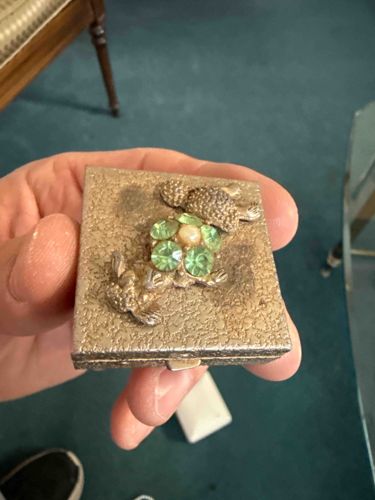
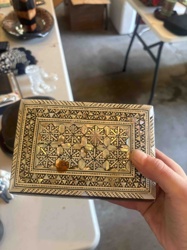
This item is a small, rectangular trinket box, possibly in the style of a pillbox or snuff box. Its primary material appears to be a metal, likely a base metal with a textured, aged patinated finish that gives it a brass or bronzed appearance, though it could be pewter or an alloy. The top surface of the box is heavily textured, resembling an organic or hammered finish, which adds to its vintage aesthetic. Prominently featured on the lid are two dimensional frog figures, crafted with textured bodies to mimic amphibian skin. They are positioned on either side of a central cluster of embellishments designed to represent lily pads and a flower. This central design consists of several faceted, emerald-green colored rhinestones, simulating lily pads, arranged around a single, small, cream-colored faux pearl, which likely represents a lily flower bud. The overall color palette is muted except for the vibrant green 'jeweled' accents. The box is handheld, as evidenced by its placement in a hand, suggesting it is relatively small, perhaps 2-3 inches in width. The hinge mechanism is visible on the front edge beneath the decorative elements, indicating it is a lidded container. The condition shows visible wear consistent with age, including areas of darkening or discoloration on the metal surface. This patina suggests it is an older piece, potentially mid-20th century, possibly dating from the 1950s to 1970s. The craftsmanship, particularly the detailed frogs and the organized placement of the 'jewels,' points to a decorative, rather than purely utilitarian, intent.
AI Appraisal Report
Based on my visual examination of the provided image, this Vintage Frog and Lily Pad Trinket Box appears to be a charming decorative item. I assess its condition as good vintage, showing expected wear and patination consistent with its age. The metal surface exhibits darkening and discoloration, which adds to its antique appeal rather than detracting significantly from it. The craftsmanship, particularly the detailed frog figures and the arrangement of the faceted green rhinestones and faux pearl, suggests a decorative piece from the mid-20th century, likely 1950s-1970s.
Market conditions for such novelty trinket boxes are generally stable, with a moderate demand among collectors of vintage decorative accessories, naturalistic themes, or specific animalia. Its rarity is not exceptionally high; similar decorative boxes, often made of base metals like pot metal, pewter, or plated alloys, are regularly found in antique malls and online marketplaces. The use of rhinestones and a faux pearl indicates it was likely an affordable, mass-produced item rather than a high-end luxury good.
Factors impacting its value include its unique design, charming aesthetic, and good overall condition. However, the use of base metals and synthetic 'jewels' limits its intrinsic material value. While authenticity can be reasonably inferred from its visual characteristics, a definitive authentication would require an in-person examination to verify the material composition, exact manufacturing techniques, and to check for any maker's marks that might be obscured or too small to see in the image. Scientific testing, such as XRF analysis, could confirm metal composition more precisely. Without physical inspection, I cannot rule out the possibility of it being a more recent reproduction, though its visible wear pattern strongly supports it being genuinely vintage.