AI Appraisal Estimate

AI-generated estimates · not official valuations

From the user

What was submitted

Photo and notes provided by the user — not generated by AI

Submitted item photo
Submitted photo · June 18, 2026

User's notes

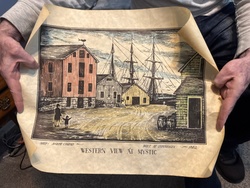
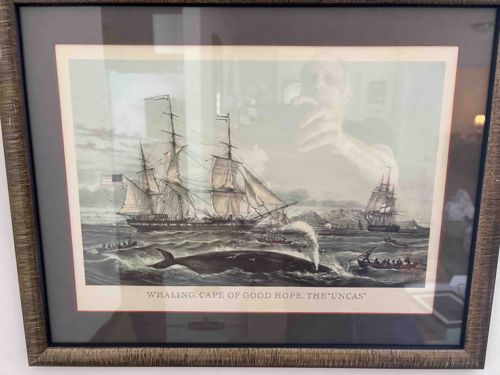
Whaling Cape of Good Hope . The Uncas

AI analysis below

AI appraisal

AI analysis & estimate

AI-Generated · Verify before acting

Everything below is generated by AI for informational purposes only. AI can make mistakes — the AI may misidentify items or misattribute them (artist, maker, brand, designer, origin, era). This is not an official valuation and should not be used for insurance, sale, tax, estate, legal, or lending purposes — or any decision requiring a certified appraisal. It is not an authoritative claim about any person, brand, or rights holder — do not share or rely on it as a factual statement about a third party. Always consult qualified professionals before making financial decisions.

Note

This analysis also relies on unverified notes provided by the user, which may be incomplete or inaccurate and could affect the result.

Read the full disclaimer

AI Identification

·Not independently authenticated·Verify before acting

Whaling, Cape of Good Hope, The 'Uncas' Nautical Print

Maritime Art and Prints

AI Estimated Value

·Not an official valuation·Verify before acting

$150 - $250

As of June 18, 2026

AI Item Analysis

·AI can make mistakes·Verify before acting
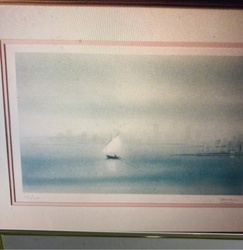
This item is a framed maritime lithographical print depicting a 19th-century whaling scene off the Cape of Good Hope, specifically identifying the vessel as the 'Uncas'. The artwork features a large three-masted whaling ship under partial sail, flying the American flag, accompanied by several smaller whaleboats engaged in the hunt. In the foreground, a prominent whale is shown breaching the water's surface with its blowhole spraying. The print utilizes a muted color palette consisting primarily of sepia tones, blacks, and subtle washes of blue and white to highlight the cresting waves and sky. The composition is characteristic of mid-19th-century maritime art, emphasizing the scale of the sea and the industry of the whaling trade. The piece is professionally matted with a dark border and a reddish-brown accent line, then housed in a textured, dark bronze or wood-tone frame with a ribbed or 'distressed' finish. The text 'WHALING, CAPE OF GOOD HOPE. THE UNCAS' is clearly printed in a serif font in the lower margin. Regarding condition, the paper appears to have some uniform aging or yellowing consistent with vintage prints, and there is visible glare on the protective glass. The frame suggests a late 20th-century assembly, though the print itself may represent an older reproduction or a well-preserved original lithograph, often based on famous sketches by Benjamin Russell.
AI Appraisal Report

·AI can make mistakes·Verify before acting
I have carefully examined the provided images of the maritime print 'Whaling, Cape of Good Hope. The Uncas'. Based on my visual analysis, this piece appears to be a high-quality mid-to-late 20th-century reproduction of the famous lithograph originally based on the sketches of Benjamin Russell (1804–1885). While the composition captures the historical gravitas of the 19th-century whaling industry, the uniform toning of the paper and the contemporary framing style—specifically the late 20th-century 'distressed' bronze-tone moulding—suggest it is a decorative offset lithograph rather than a mid-1800s original pulled from a stone. The market for maritime prints remains steady among collectors of 'Nauticalia,' though values are heavily bifurcated between original Currier & Ives or Endicott & Co. lithographs and modern reproductions. Comparables for framed reproductions of this specific Russell subject typically sell in the $100 to $300 range at regional auctions. The 'Uncas' is a popular subject, which ensures demand but limits rarity. A significant limitation of this appraisal is the presence of protective glass, which prevents a microscopic inspection of the printing process (e.g., checking for a dot matrix vs. continuous tone) and the paper's watermark. To fully authenticate this as a 19th-century original—which could increase the value tenfold—an in-person examination is required to remove the backing, inspect the paper fibers for rag content, and verify the presence of hand-coloring versus mechanical ink application. Provenance documentation or a gallery label from a known maritime specialist would also be necessary to justify a higher valuation.

Get your items appraised

Instant estimates of your treasures with AI-powered appraisals

Browse More Appraisals