AI estimate as of July 25, 2025 · verify with a professional before acting
AI-Generated · Verify before acting
Everything on this page is generated by AI for informational purposes only. AI can make mistakes — the AI may misidentify items or misattribute them (artist, maker, brand, designer, origin, era). This is not an official valuation and should not be used for insurance, sale, tax, estate, legal, or lending purposes — or any decision requiring a certified appraisal. It is not an authoritative claim about any person, brand, or rights holder — do not share or rely on it as a factual statement about a third party. Always consult qualified professionals before making financial decisions.
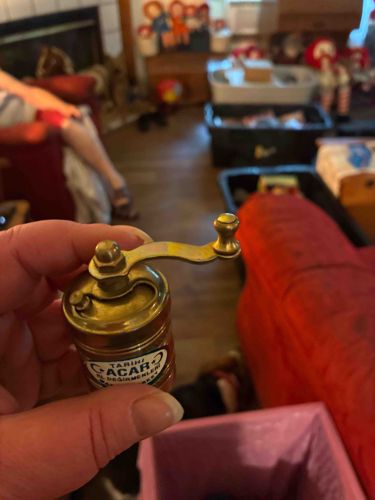
This item is a miniature, hand-cranked spice or coffee grinder, likely designed for either functional use in a small capacity or as a decorative novelty item. It is predominantly constructed from brass or a brass-toned metal, as indicated by its golden hue and the characteristic patina developing on its surface. The body of the grinder is cylindrical, featuring a ribbed or fluted design on its lower half. A notable feature is the label on the side, which appears to be in a non-English language, possibly Turkish, with 'TARINI AGAR' and 'DEĞIRMENLER' being partially visible, suggesting a brand name or type of mill. The grinding mechanism is operated by a top-mounted, bent-arm crank with a small, rounded knob for grip. The overall construction appears solid and well-made, typical of traditional manual grinders. Visible condition issues include a darkening or tarnishing of the brass, consistent with age and exposure, which forms a natural patina giving it an antique appearance. There are no immediate signs of significant damage like dents or breaks, but minor surface scratches or wear from use might be present upon closer inspection. The quality of craftsmanship seems to be good, with precise fitting of components for smooth operation of the crank. Based on similar items, it likely dates from the mid-20th century or later, possibly as a souvenir or a compact travel item. Its small size suggests it is either for individual portions or fine grinding of delicate spices.
AI Appraisal Report
Based on my visual examination of the provided image, this Miniature Brass Hand Grinder, consistent with the 'Acar' type, appears to be in good, albeit patinated, condition. The brass construction shows natural darkening and tarnish, which is expected for an item of its presumed age and material, enhancing its antique appeal rather than detracting significantly. I observe no obvious major dents, cracks, or breaks. The ribbed design, top-mounted crank, and the present label (likely 'TARINI AGAR DEĞIRMENLER', suggesting Turkish origin) all point to its authenticity as a mid-20th century, possibly functional yet often decorative, miniature grinder.
Market conditions for such miniature brass grinders are generally stable. These items appeal to collectors of kitchenware, miniatures, and brass artifacts. Comparables typically sell in a modest range, as they are not exceedingly rare, although well-preserved examples with clear provenance or unique features might command higher prices. Demand is moderate, driven by niche collectors rather than broad appeal. Factors impacting value here include its good structural integrity, the charming patina, and the clear branding.
It is important to note the limitations of assessing authenticity solely from images. While the visual cues are strong, a physical inspection would be needed to confirm the exact metal composition, test the grinding mechanism's functionality, and assess any minute surface wear not visible in the photograph. Furthermore, documentation of provenance, though unlikely for an item of this value, would solidify its history. Scientific testing, such as elemental analysis of the brass, could confirm its precise age and composition, but this is typically reserved for much higher-value items.