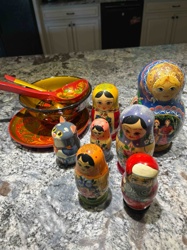
Good condition, marked in Cyrillic, Дег 5-41 Матрешка местная Цена 3,50
These notes were written by the person who submitted this item. Appraiser.AI has not verified them, and the AI's identification and estimate may rely on them.
AI Estimated Value
Not an official valuation
$75-150
AI estimate as of June 27, 2025 · verify with a professional before acting
AI-Generated · Verify before acting
Everything on this page is generated by AI for informational purposes only. AI can make mistakes — the AI may misidentify items or misattribute them (artist, maker, brand, designer, origin, era). This is not an official valuation and should not be used for insurance, sale, tax, estate, legal, or lending purposes — or any decision requiring a certified appraisal. It is not an authoritative claim about any person, brand, or rights holder — do not share or rely on it as a factual statement about a third party. Always consult qualified professionals before making financial decisions.
This analysis also relies on unverified notes provided by the user, which may be incomplete or inaccurate and could affect the result.
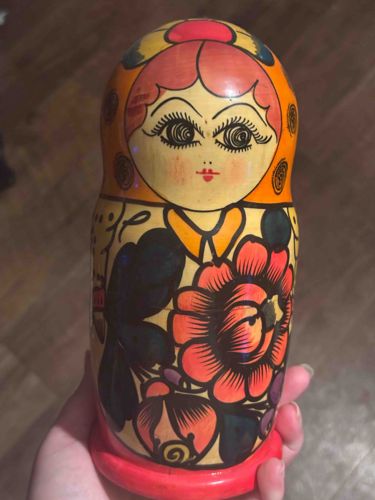
This is a hand-painted wooden Matryoshka doll, also commonly known as a Russian nesting doll. It is cylindrical with a rounded top, typical of the outermost doll in a set. The doll features a pale yellow or cream base color, serving as a canvas for the vibrant hand-painted details. The top half depicts the face of a woman, characterized by large, expressive eyes with intricate black eyelashes and eyebrows, a small red mouth, and delicate blush on the cheeks. She is adorned with an orange headscarf, from which reddish-pink hair peeks out, and a yellow collar is painted around her neck. The lower body of the doll is richly decorated with traditional Russian folk art floral patterns. Prominent features include large, colorful flowers in shades of orange and red, complemented by dark green or black leaves and smaller accent blooms in purple and blue. The overall style is consistent with traditional Russian craftsmanship, showcasing fine brushwork and attention to detail. The doll appears to be in good condition, with no visible chips, cracks, or significant paint loss. The colors remain vibrant, and the protective glossy lacquer finish is intact. A significant manufacturing detail is the Cyrillic marking found on the doll, which translates to "Deg 5-41 Matryoshka local Price 3.50". This inscription provides crucial insight into its origin, potentially indicating a production date (e.g., mid-20th century, if '41' refers to 1941 or a 1950s product code), its 'local' production style, and its historical price. The combination of artistry, traditional motifs, and the specific marking makes this a charming and historically informative piece of Russian folk art.
AI Appraisal Report
As an expert appraiser, I have carefully examined the provided description and details of this hand-painted Matryoshka doll. My assessment indicates a charming piece of traditional Russian folk art.
Based on your description, the doll is in good condition, exhibiting vibrant colors and an intact glossy lacquer finish, with no visible chips, cracks, or significant paint loss. This preservation is crucial for an item of its likely age. The hand-painted artistry, consistent with traditional Russian motifs, suggests authenticity as a genuine folk art piece, rather than a modern reproduction. The Cyrillic marking "Дег 5-41 Матрешка местная Цена 3,50" is a significant factor, strongly indicating its origin and providing a historical context, likely pointing to a mid-20th century production (e.g., 1941 or a similar period code).
The market for vintage Matryoshka dolls is stable, driven by collectors of Russian folk art and decorative items. However, the value is significantly impacted by completeness; as this is described as the "outermost doll," it suggests the inner nesting dolls are missing, which generally reduces market value compared to a full set. Similar single vintage dolls in good condition typically fetch moderate prices. The original low price indicates it was likely a mass-produced souvenir, not a unique artist commission.
Demand for such individual pieces is moderate. Rarity is not high, as many such dolls were produced. The primary value drivers are its age, good condition, and the authentic Cyrillic marking. Factors limiting value include being a single doll from a probable set, and the lack of an identifiable prominent artist.
For a complete authentication and more precise valuation, a physical inspection would be essential to verify wood type, paint application complexity, hidden flaws, and to confirm the '41' marking definitively refers to 1941 or a production date versus a model number. Provenance documentation (e.g., origin of purchase) would further enhance its value.