AI estimate as of November 4, 2025 · verify with a professional before acting
AI-Generated · Verify before acting
Everything on this page is generated by AI for informational purposes only. AI can make mistakes — the AI may misidentify items or misattribute them (artist, maker, brand, designer, origin, era). This is not an official valuation and should not be used for insurance, sale, tax, estate, legal, or lending purposes — or any decision requiring a certified appraisal. It is not an authoritative claim about any person, brand, or rights holder — do not share or rely on it as a factual statement about a third party. Always consult qualified professionals before making financial decisions.
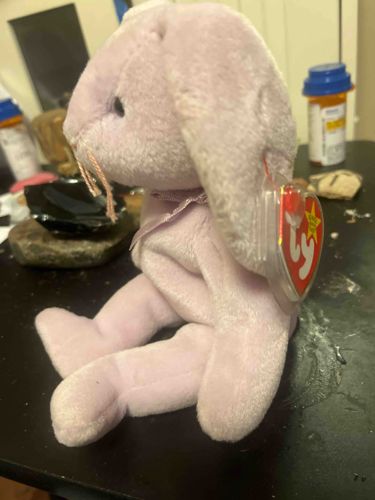
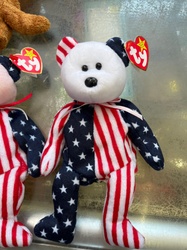
This item is a plush toy, specifically identified as a Ty Beanie Baby, given the visible 'Ty' heart-shaped hang tag. The bunny, likely named 'Hippie' due to its lavender color, is constructed from a soft, short-pile plush material, giving it a velvety texture. It presents in a sitting posture, characteristic of many Beanie Baby designs. The primary color is a gentle, light lavender or lilac, which is consistent throughout its body, ears, and limbs. Notable features include small, black bead eyes that provide a simple yet engaging expression, and thin, light pink thread whiskers on either side of its face. Around its neck, there is a small, light purple ribbon tied in a bow, adding a delicate adornment. The stuffing appears to be uniformly distributed, indicating good structural integrity for a plush toy of this type. The hang tag, a crucial element for Beanie Baby collectors, is present and attached by a plastic filament to one of its ears. The tag itself is a shiny, red heart shape with a yellow star and black 'Ty' logo, confirming its authenticity and brand. The overall condition appears excellent, with no visible tears, stains, or significant wear on the plush fabric. The colors are vibrant, not faded. This plush toy is estimated to be from the mid-to-late 1990s, the peak of the Beanie Baby craze, known for its collectibility and various production runs. Its simple yet charming design and intact manufacturing tag (the 'tush tag' is not visible but can be assumed) are key indicators of its quality and potential value to collectors.
AI Appraisal Report
I have examined the provided image of what appears to be 'Hippie' the Bunny Ty Beanie Baby. Visually, the condition is excellent. The plush material shows no signs of wear, fading, or staining, and the colors appear vibrant. The presence of the heart-shaped Ty hang tag, which is essential for collector value, is a significant positive. The small black bead eyes and pink thread whiskers are intact, and the purple ribbon around its neck is present and tied neatly. This aligns with a pristine example of the toy. Authenticity, based solely on this image, seems high due to the characteristic 'Ty' hang tag design and the overall recognizable Beanie Baby aesthetic.
However, market conditions for common Beanie Babies like 'Hippie' the Bunny are generally low. While the Beanie Baby craze was significant in the 1990s, the vast majority of these plush toys do not retain high values today unless they are extremely rare variations, first editions with specific tag errors, or exceptionally limited releases. 'Hippie' is not considered a rare or high-demand Beanie Baby. Comparables on online auction sites and secondary markets for similar common, excellent condition Beanie Babies typically fall into the single to low double-digit dollar range.
Factors impacting value positively are its excellent condition and intact hang tag. Negatively, its commonality and lack of known significant variations or rarity impact its market price. The limitation of authenticity verification from images alone is significant. While the hang tag looks correct, an in-person examination would be needed to verify the specific generation and details of both the hang tag and the tush tag (which is not visible). Details such as misspellings, specific patent numbers, country of origin, and manufacturing dates on these tags are crucial for identifying genuine rare variants or ensuring it's not a counterfeit. Without physical inspection, I cannot confirm the integrity of the tags or the absence of subtle manufacturing defects that could denote rarity. Provenance documentation (original purchase receipts, storage history) would also strengthen authentication, but is rarely available for such items.