AI estimate as of October 25, 2025 · verify with a professional before acting
AI-Generated · Verify before acting
Everything on this page is generated by AI for informational purposes only. AI can make mistakes — the AI may misidentify items or misattribute them (artist, maker, brand, designer, origin, era). This is not an official valuation and should not be used for insurance, sale, tax, estate, legal, or lending purposes — or any decision requiring a certified appraisal. It is not an authoritative claim about any person, brand, or rights holder — do not share or rely on it as a factual statement about a third party. Always consult qualified professionals before making financial decisions.
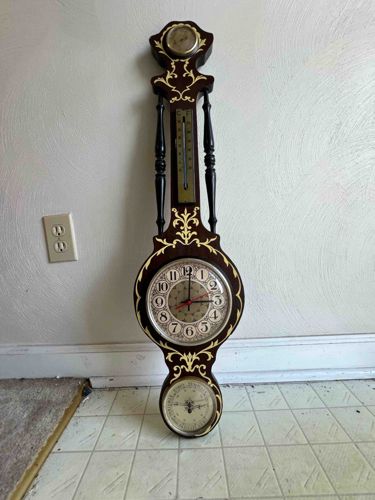
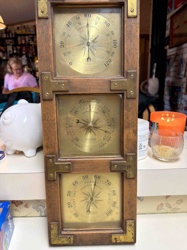
This item is a vintage wall-mounted banjo-style weather station and clock, characterized by its elongated, decorative wooden frame. The frame appears to be made of a dark-stained wood, possibly mahogany or walnut, featuring intricate gold or cream-colored scrollwork and foliate motifs painted or applied to its surface. The overall form is reminiscent of a banjo, with a narrower 'neck' expanding into a broader 'body' at the bottom.
Starting from the top, there is a small, round encased dial, likely a barometer, indicating atmospheric pressure. Below this, integrated into the 'neck' of the frame, is a vertical mercury-based thermometer, displaying temperature readings. Flanking the thermometer are two turned, black-finished wooden spindles or balusters, adding to its classical aesthetic.
Further down, dominating the main 'body' section, is a circular clock face. The clock features a light-colored, possibly off-white or cream, dial with black Arabic numerals for hours and minute markers. It has red hour and minute hands, along with a black second hand. The clock face is surrounded by a silver-toned bezel.
At the very bottom, another circular dial is present, which is likely a hygrometer, measuring humidity, or possibly a secondary barometer. This dial also features a silver-toned bezel. The entire piece exhibits signs of age, including a visible patina on the wooden finish and some wear on the gold decorative elements. The dials of the instruments appear to have some discoloration or minor surface degradation consistent with older pieces. There are no obvious signs of major damage or repairs from the provided images, but close inspection would be needed to confirm the condition of the internal mechanisms and the integrity of the wood. The style suggests a mid-20th century production, perhaps from the 1940s to 1960s, adopting a traditional or colonial revival aesthetic.
AI Appraisal Report
I have visually examined this vintage wall-mounted banjo-style weather station and clock. Based on the provided description, the condition appears to be good vintage, with expected signs of age including patina on the dark-stained wood, wear on applied decorative elements, and some discoloration on the instrument dials. There are no obvious signs of major damage or repair, which is positive for its value. The combination of barometer, thermometer, clock, and hygrometer (or secondary barometer) in a decorative banjo style points to a mid-20th century production, likely between the 1940s and 1960s, reflecting a traditional or Colonial Revival aesthetic.
Authenticity of the period seems consistent with the visual cues, though without physical inspection, I cannot verify the integrity of the internal mechanisms or the type of wood used (e.g., solid mahogany/walnut vs. veneer). Mid-century weather stations like this are relatively common in the vintage market. While decorative, they are not exceedingly rare, and demand is moderate, often driven by collectors of specific decor styles or those seeking functional vintage pieces. Factors impacting value include the functionality of all instruments, the presence of mercury in the thermometer (which can be a concern for some buyers), and the overall condition of the decorative elements. Higher values would be achieved if all instruments are confirmed to be fully functional and accurate. In-person examination would be crucial to assess the working order of each instrument, verify the wood type and condition beneath the patina, and determine if any repairs or replacements have been made to the internal components. Provenance documentation would add to its history but is rarely available for such items. Considering these factors, I estimate the value to be in the range of $75 to $150, assuming functional components and good overall structural integrity.