AI estimate as of August 22, 2025 · verify with a professional before acting
AI-Generated · Verify before acting
Everything on this page is generated by AI for informational purposes only. AI can make mistakes — the AI may misidentify items or misattribute them (artist, maker, brand, designer, origin, era). This is not an official valuation and should not be used for insurance, sale, tax, estate, legal, or lending purposes — or any decision requiring a certified appraisal. It is not an authoritative claim about any person, brand, or rights holder — do not share or rely on it as a factual statement about a third party. Always consult qualified professionals before making financial decisions.
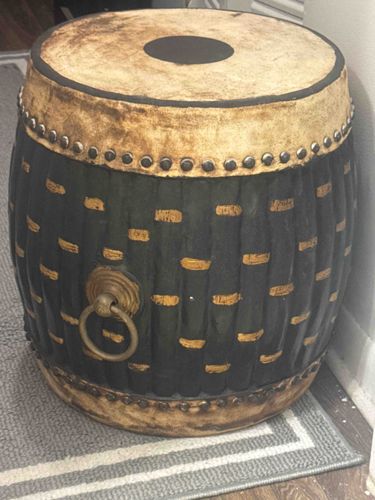
This item is a large, circular, barrel-shaped drum, likely intended for decorative purposes but possibly functional as a percussion instrument. Its primary colors are dark, almost black, on the main body, contrasted with a yellowish-brown, possibly distressed, skin or fabric covering on the top and bottom rims. The dimensions appear substantial, making it suitable as a low stool or side table as well. The main body features vertical ribbed or fluted sections, each adorned with multiple horizontal, rectangular, golden-colored embellishments, creating a patterned effect. Around the top and bottom rims, the yellowish-brown material is secured with numerous small, dark-colored studs or tacks, giving it a rustic or antique appearance. A prominent feature on the side of the drum is a large, brass-toned or dark bronze handle, designed in the shape of a lion's head or similar ornate motif, with a hanging ring attached, further enhancing its decorative value. The top surface, made of the same yellowish-brown material, has a distinct circular black patch in the center. The overall condition shows signs of potential wear or intentional distressing, contributing to its aged aesthetic. The textures visible on the top and bottom suggest either animal skin or a heavy, textured fabric. The craftsmanship suggests a sturdy construction, though without closer inspection, specific materials like wood, metal, or composite used for the barrel body cannot be definitively identified. The style points to an antique, possibly ethnic, or tribal-inspired design, perhaps invoking East Asian or African influences. There are no visible maker's marks or signatures. The dark black body with golden accents, coupled with the riveted details and decorative handle, give it a substantial and eye-catching presence.
AI Appraisal Report
Based on my visual examination of the provided image, this decorative barrel drum/stool presents as a robust and aesthetically intriguing piece. The overall condition appears to be good, with signs of intentional distressing contributing to its aged aesthetic rather than detracting from its appeal. The dark body with golden accents, riveted yellowish-brown top/bottom rims, and the ornate lion's head handle suggest a well-crafted item. Authenticity is challenging to definitively assess from images alone. While it appears to be a vintage or antique-inspired piece, I cannot confirm materials or genuine age without physical inspection.
Market conditions for decorative drums or unique stools/side tables with an ethnic or tribal aesthetic are generally stable, though demand can be niche. Comparable items found in decorative arts markets, particularly those with a global or eclectic appeal, might range widely. Pieces sold through antique dealers or specialty home decor shops tend to command higher prices than those from general auctions. Rarity is difficult to ascertain without knowing its origin; it could be a mass-produced decorative item or a unique, handcrafted piece. The lack of visible maker's marks limits authentication in this regard.
Factors significantly impacting value include the actual materials (e.g., solid wood vs. composite, genuine animal hide vs. synthetic fabric), the true age, and the quality of craftsmanship upon closer inspection. The functional versatility as both a decorative drum and a stool also adds to its marketability. For full authentication and a more precise valuation, an in-person examination is crucial to assess construction methods, material quality, and confirm wear patterns. Provenance documentation, if available, would be invaluable. Scientific testing, such as carbon dating for organic materials or metallurgical analysis for the handle, would only be pursued if the piece was believed to be of significant historical or cultural importance, which cannot be determined from the image.