AI estimate as of October 17, 2025 · verify with a professional before acting
AI-Generated · Verify before acting
Everything on this page is generated by AI for informational purposes only. AI can make mistakes — the AI may misidentify items or misattribute them (artist, maker, brand, designer, origin, era). This is not an official valuation and should not be used for insurance, sale, tax, estate, legal, or lending purposes — or any decision requiring a certified appraisal. It is not an authoritative claim about any person, brand, or rights holder — do not share or rely on it as a factual statement about a third party. Always consult qualified professionals before making financial decisions.
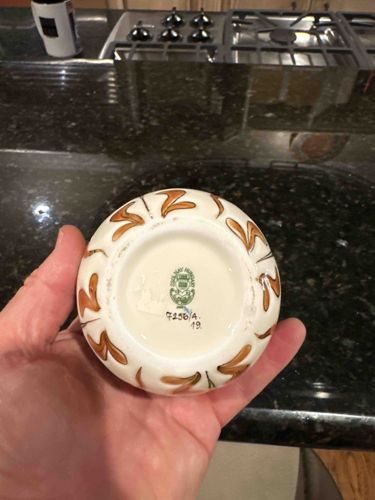
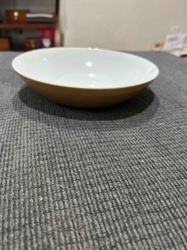
This item is a small, circular porcelain dish, likely a butter pat or a miniature trinket dish, manufactured by Herend. The primary color of the porcelain is a pristine white, serving as a bright canvas for the hand-painted decoration. The design on its exterior features stylized, organic leaf-like or abstract flowing motifs in a warm, earthy brown or caramel color. These motifs appear to be a variant or complementary pattern to Herend's well-known 'Rothschild Bird' collection, although the birds themselves are not visible in this particular view. The craftsmanship of the painting suggests intricate hand-application, indicating the high quality typical of Herend porcelain. The reverse side, specifically the base, reveals the item's manufacturing details. A clear green Herend mark, possibly a shield or crest with text, is centered on the bottom, affirming its origin. Below this mark, handwritten or hand-stamped numbers '7256/A.' and '19' are visible. '7256/A.' likely refers to the pattern or shape number, while '19' could denote a decorator's mark, a production batch, or a date code, though without further context, its exact meaning is speculative. The dish appears to be in excellent condition with no visible chips, cracks, repairs, or significant wear. The glaze is glossy and intact, reflecting light evenly. Its small size, careful decoration, and identifiable maker's mark point to it being a collectible piece of fine porcelain. The exact age is not provided, but Herend items with similar marks often date from the mid-20th century to more contemporary periods.
AI Appraisal Report
Upon visual examination of the Herend porcelain butter pat, it presents as a genuine piece from the esteemed Hungarian manufactory. The hand-painted decoration, while a variant, is consistent with the 'Rothschild Bird' pattern style, and the green Herend maker's mark on the base, along with the hand-applied form number '7256/A.' and what is likely a decorator's mark '19', all align with authentic Herend production practices. The item appears to be in excellent condition, with no visible chips, cracks, or repairs, which is crucial for maintaining value in porcelain collectibles.
The market for Herend porcelain is well-established, with the 'Rothschild Bird' pattern being one of its most popular and widely collected designs. However, the value of individual pieces is highly dependent on their form, size, and function. Small items like butter pats, while charming, are relatively common and have a lower price point compared to larger serving pieces or decorative objects. Current market comparables for similar Herend butter pats or small trinket dishes typically sell in the $25 to $45 range on secondary markets, depending on the retailer and specific decoration.
The valuation is based solely on the provided description and digital images. Full authentication would require in-person examination to assess the glaze texture, porcelain quality, and the execution of the painted mark under magnification, as forgeries can replicate these details with varying success. A physical inspection would also confirm the absence of hairline cracks or restorations not visible in photographs. Without provenance documentation or physical inspection, the authenticity is presumed, not certified.