AI Appraisal Estimate

AI-generated estimates · not official valuations

From the user

What was submitted

Photo and notes provided by the user — not generated by AI

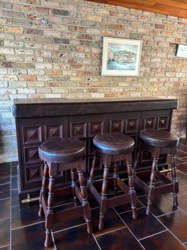
Submitted item photo
Submitted photo · June 17, 2026

User's notes

Antique bar

AI analysis below

AI appraisal

AI analysis & estimate

AI-Generated · Verify before acting

Everything below is generated by AI for informational purposes only. AI can make mistakes — the AI may misidentify items or misattribute them (artist, maker, brand, designer, origin, era). This is not an official valuation and should not be used for insurance, sale, tax, estate, legal, or lending purposes — or any decision requiring a certified appraisal. It is not an authoritative claim about any person, brand, or rights holder — do not share or rely on it as a factual statement about a third party. Always consult qualified professionals before making financial decisions.

Note

This analysis also relies on unverified notes provided by the user, which may be incomplete or inaccurate and could affect the result.

Read the full disclaimer

AI Identification

·Not independently authenticated·Verify before acting

Art Deco Walnut Veneer Cocktail Sideboard

Antique Furniture / Dining Room & Bar

AI Estimated Value

·Not an official valuation·Verify before acting

$450 - $700

As of June 17, 2026

AI Item Analysis

·AI can make mistakes·Verify before acting
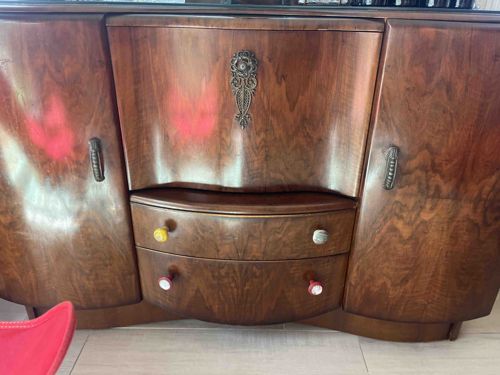
This is a mid-20th-century Art Deco style cocktail cabinet or sideboard, characterized by its distinctive curved front and rich book-matched walnut veneers. The piece features a central flip-top or fall-front drink compartment adorned with an ornate, vertically oriented cast metal escutcheon plate, likely made of brass or bronze with a dark patina. Below the central cabinet are two bowed drawers, which currently feature mismatched, non-original replacement knobs in various colors (yellow, white, and red), indicating a loss of original hardware. Flanking the center are two large curved cupboard doors with matching vertical metal handles. The wood shows a warm, medium-brown finish with a high-gloss sheen, emphasizing the dramatic grain patterns typical of the 1930s-1940s era. Regarding condition, there are visible surface scratches, minor indentations, and what appears to be some localized finish wear or light reflections on the left and center panels. The base is a continuous plinth style, consistent with late Deco and Streamline Moderne furniture design. The overall craftsmanship suggests a mass-produced but high-quality domestic piece from the post-depression era, likely British or American in origin.
AI Appraisal Report

·AI can make mistakes·Verify before acting
Upon examination of this Art Deco cocktail sideboard, I find it to be a quintessential piece of mass-market luxury furniture from the late 1930s to early 1940s. The use of book-matched walnut veneers and the 'cloud' or bowed silhouette is characteristic of high-volume British manufacturers of the era. The primary value-driver is the dramatic veneer work and the functional cocktail compartment. However, the condition presents several challenges. The most significant detraction is the loss of original hardware on the central drawers, replaced with incongruous modern knobs that disrupt the aesthetic unity of the piece. The surface shows typical age-related wear, including finish abrasions and minor clouding. In the current market, Art Deco furniture remains popular for interior styling, but mass-produced domestic pieces face stiff competition from restored examples. Comparables for uncurated pieces in this condition generally fall in the sub-$1,000 range. The value would appreciate significantly if the hardware were replaced with period-correct bakelite or stamped brass handles and the finish underwent a professional French polish. Limitations of this virtual appraisal: I cannot verify the structural integrity of the plinth base or the interior condition of the cocktail cabinet (mirroring, glass shelving, or lighting). Full authentication would require an in-person inspection to check for maker’s marks—such as 'Epstein' or 'Hille'—which could triple the valuation. I would also need to examine the drawer joinery (dovetailing) and the secondary woods used for the carcass to confirm the exact origin and quality tier.

Get your items appraised

Instant estimates of your treasures with AI-powered appraisals

Browse More Appraisals