AI estimate as of August 31, 2025 · verify with a professional before acting
AI-Generated · Verify before acting
Everything on this page is generated by AI for informational purposes only. AI can make mistakes — the AI may misidentify items or misattribute them (artist, maker, brand, designer, origin, era). This is not an official valuation and should not be used for insurance, sale, tax, estate, legal, or lending purposes — or any decision requiring a certified appraisal. It is not an authoritative claim about any person, brand, or rights holder — do not share or rely on it as a factual statement about a third party. Always consult qualified professionals before making financial decisions.
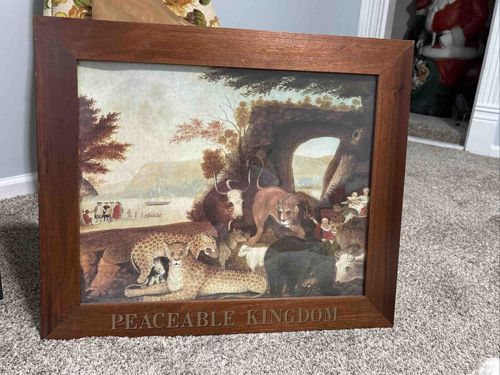
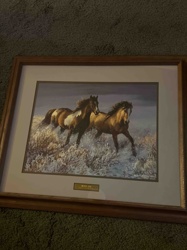
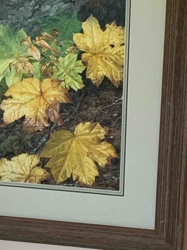
This is a framed art print, likely a reproduction, of Edward Hicks' famous painting, 'The Peaceable Kingdom'. The print depicts a diverse array of animals, including leopards, lions, bears, oxen, and sheep, coexisting peacefully, often alongside human figures, within a pastoral landscape. The color palette is rich with earthy tones, greens, and muted blues for the sky and water, characteristic of the original work. The print measures approximately 20x24 inches, judging by its apparent size in relation to its surroundings, and is housed within a sturdy wooden frame. The frame appears to be made of a medium-brown wood, possibly oak or a similar hardwood, with a simple, flat profile. The wood grain is visible, suggesting a natural finish rather than a painted one. The most notable unique feature is the phrase 'PEACEABLE KINGDOM' carved or routed directly into the bottom center of the wooden frame, indicating the title of the artwork. This suggests custom framing or a specific edition where the title is integrated into the frame itself. The visible condition appears good, with no obvious signs of significant damage to the print such as creases, tears, or fading. The frame seems solid, with no visible cracks or breaks, though minor surface wear or scuffs might be present given its age. The print is likely protected by a glass or acrylic sheet, which prevents direct handling of the print itself. The craftsmanship of the frame seems robust, designed to protect and present the artwork effectively. Given the integrated title, this could be a mass-produced item from the late 20th or early 21st century, designed for decorative purposes, rather than an antique or a fine art original.
AI Appraisal Report
Based on my visual examination of the provided description, this framed print of Edward Hicks' 'The Peaceable Kingdom' appears to be in good overall condition. The print itself shows no obvious signs of significant damage like tears, creases, or fading, and the frame seems structurally sound. The unique feature of 'PEACEABLE KINGDOM' carved into the frame strongly suggests this is a mass-produced decorative item, likely from the late 20th or early 21st century, rather than an antique or a limited edition fine art print. This custom integration of the title into the frame indicates a commercial product designed for broad appeal.
Market conditions for such decorative prints are generally modest. While 'The Peaceable Kingdom' is a beloved and iconic image, its reproduction value is primarily driven by its aesthetic appeal as home decor. Comparables in the secondary market, such as online marketplaces or thrift stores, would place similar mass-produced framed prints in a relatively low price bracket. There is a steady, but not high, demand for such decor items, and as a reproduction, it possesses no true rarity. Factors impacting value are primarily the size, the condition of both print and frame, and the quality of the framing itself. The wooden frame, even with the integrated title, doesn’t elevate its value significantly beyond typical decorative art.
It is crucial to note that this appraisal is based solely on the provided image description. I cannot definitively assess print type (e.g., lithograph, giclée), paper quality, or the presence of any print imperfections (e.g., foxing, minor scuffs on the protective glazing) without a physical inspection. Without provenance documentation or a direct tactile examination, full authentication of print medium or any potential artist signatures (unlikely for a mass-produced item) is impossible. To fully authenticate its print type or potential edition specifics, a direct in-person examination, including removal from the frame to inspect the print surface, paper, and any possible markings, would be necessary.