AI estimate as of October 10, 2025 · verify with a professional before acting
AI-Generated · Verify before acting
Everything on this page is generated by AI for informational purposes only. AI can make mistakes — the AI may misidentify items or misattribute them (artist, maker, brand, designer, origin, era). This is not an official valuation and should not be used for insurance, sale, tax, estate, legal, or lending purposes — or any decision requiring a certified appraisal. It is not an authoritative claim about any person, brand, or rights holder — do not share or rely on it as a factual statement about a third party. Always consult qualified professionals before making financial decisions.
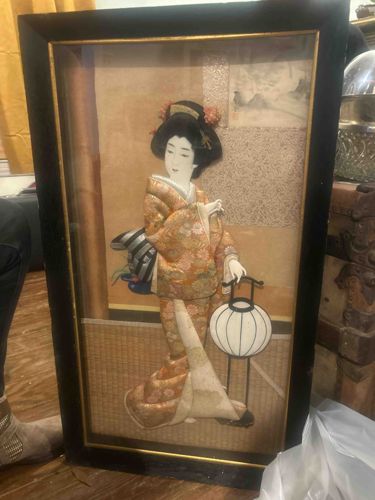
This item is a framed piece of three-dimensional art depicting a Japanese geisha figure. The artwork is presented within a black wooden frame with a subtle gold inner trim, suggesting a classic and sturdy presentation for the piece. The geisha figure itself is constructed using various materials to create a立体 (rittai - three-dimensional) effect, likely incorporating embossed paper, fabric textiles, and possibly modeling paste or a similar medium for the face and hands. The figure's kimono is a prominent feature, displaying a rich, brocade-like pattern in shades of orange, gold, and subtle greens, indicative of a detailed textile application. The obi (sash) is rendered in a contrasting black and silver striped pattern. The geisha's face is delicately painted, featuring traditional Japanese makeup, and her hair is styled in an elaborate updo adorned with red floral elements. She holds a white, ribbed paper lantern with black supports, adding depth and narrative to the scene. The background behind the geisha is multi-layered; a beige or light brown textured material forms the immediate backdrop, while intricate patterns resembling traditional Japanese screens or panels are visible in the upper and lower sections, along with a small, darker-toned landscape painting or print inset at the top right. The base features a woven pattern, possibly representing a tatami mat or similar flooring. The overall construction suggests a mid-20th century to late 20th century stylistic period, characterized by such framed fiber art or embossed relief pieces. Condition appears good from the image, with no obvious signs of significant damage to the figure or frame, though closer inspection would be needed to assess any discoloration, fabric fraying, or stress cracks. The craftsmanship appears to be of good quality, with attention to detail in the costume and accessories. This piece stands out due to its detailed three-dimensional construction and the use of mixed media to create a realistic and cultural depiction.
AI Appraisal Report
I've examined the provided image of this Framed Japanese Embossed/Textile Geisha Art. The piece presents as a charming mid to late 20th-century decorative item, characteristic of the 'ritti' style. Visually, the condition appears good, with no obvious major damage to the frame or the intricate three-dimensional geisha figure. The textile work on the kimono, embossed details, and painted face all seem well-preserved from the visual evidence. However, without a physical inspection, I cannot definitively assess for subtle discoloration, fabric fraying, stress cracks in the modeling paste, or dust accumulation within the framed space. The authenticity, particularly regarding the materials and age, is largely congruent with similar mass-produced or studio-created decorative arts from the specified period. Comparables in the market for such framed fiber art or embossed relief pieces typically range from $100-$300, depending on size, intricacy, and specific artist if known (which is rare for these types of pieces). Demand is moderate, appealing mainly to collectors of Asian decorative arts or those seeking eclectic home decor. It's not a rare item, as many similar pieces were produced. Factors impacting value positively include its good apparent condition and detailed craftsmanship. Conversely, its likely mass-produced nature and lack of artist attribution limit its top-tier value. Full authentication would require in-person examination to verify material composition, confirm manufacturing techniques, and check for any artist signatures hidden within the piece or on the reverse, which is impossible from an image. Provenance documentation would also be ideal to confirm its history and origins.