AI Appraisal Estimate

AI-generated estimates · not official valuations

From the user

What was submitted

Photo and notes provided by the user — not generated by AI

Submitted item photo
Submitted photo · May 19, 2026

User's notes

No additional notes provided.

AI analysis below

AI appraisal

AI analysis & estimate

AI-Generated · Verify before acting

Everything below is generated by AI for informational purposes only. AI can make mistakes — the AI may misidentify items or misattribute them (artist, maker, brand, designer, origin, era). This is not an official valuation and should not be used for insurance, sale, tax, estate, legal, or lending purposes — or any decision requiring a certified appraisal. It is not an authoritative claim about any person, brand, or rights holder — do not share or rely on it as a factual statement about a third party. Always consult qualified professionals before making financial decisions.

Read the full disclaimer

AI Identification

·Not independently authenticated·Verify before acting

Four-Light Ornate Silver-Plated Candelabrum

Home Decor & Silverware

AI Estimated Value

·Not an official valuation·Verify before acting

$45 - $75

As of May 19, 2026

AI Item Analysis

·AI can make mistakes·Verify before acting
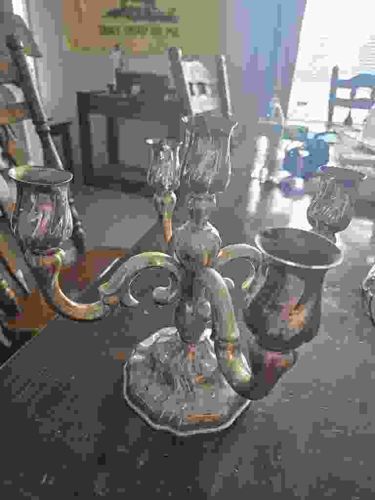
This is a four-light candelabrum, likely made of silver-plated copper or brass, exhibiting a classic Rococo Revival or Baroque-inspired style common in the mid-to-late 20th century. The piece features a central upright candle socket flanked by three curved, radiating arms that terminate in matching tulip-shaped sconces with flared, scalloped rims. The central column is baluster-shaped with bulbous segments, resting on a weighted, tiered circular base that appears to have an embossed or repousse decorative pattern around its edge. Each arm is cast with scroll motifs and subtle foliage details, characteristic of ornate European traditional design. The construction appears to be multi-part, with the arms possibly being removable or bolted to the central stem. Regarding condition, the item shows significant visible tarnish and oxidation, presenting a dark gray and blackish patina that obscures the original bright silver shine. There are noticeable warm coppery or brassy highlights appearing through the plating on the high points and inner curves of the arms, indicating considerable wear to the silver layer (plate loss). While no maker's marks are visible in the low-resolution image, the style suggests it could be a production by mid-century American or European silver companies like International Silver, Poole, or Leonard. The craftsmanship reflects a mass-produced decorative item intended for formal dining-room aesthetics. There are no obvious structural breaks, but the accumulation of dust and the degradation of the surface finish suggest a need for professional cleaning and possible replating if a pristine appearance is desired.
AI Appraisal Report

·AI can make mistakes·Verify before acting
Based on my visual examination of the four-light silver-plated candelabrum, I have assessed the item as a mid-20th-century decorative piece consistent with the Rococo Revival style. The construction features cast scrollwork and a baluster stem typical of mass-produced silver-plate by manufacturers such as Leonard or International Silver. The condition is a primary factor in this valuation; the item displays heavy oxidation and significant 'bleeding,' where the base metal (likely copper) is visible through the silver plating. This level of plate loss suggests frequent polishing or poor storage, necessitating costly replating to restore its original aesthetic. The market for silver-plated hollowware is currently soft, as modern consumer preferences trend toward low-maintenance decor. Rarity is minimal, as similar pieces were produced in large quantities for the middle-market bridal and home giftware registries between 1950 and 1980. Comparable sales on secondary markets for unpolished, worn silver-plate candelabra typically fall within the $40 to $80 range. Should the item bear a prestigious maker’s mark (e.g., Gorham or Reed & Barton), the value would sit at the higher end of that estimate. Limitations: This appraisal is based solely on digital imagery. Verification of the base metal and identification of specific maker’s marks—which may be hidden under tarnish on the underside of the weighted base—require physical inspection. A professional cleaning is necessary to rule out structural pitting or 'leprosy' (corrosion of the base metal). Without a physical hallmark or provenance documentation, I cannot definitively confirm the manufacturer or the exact thickness of the silver deposit.

Get your items appraised

Instant estimates of your treasures with AI-powered appraisals

Browse More Appraisals