These notes were written by the person who submitted this item. Appraiser.AI has not verified them, and the AI's identification and estimate may rely on them.
AI Estimated Value
Not an official valuation
$400-600
AI estimate as of October 28, 2025 · verify with a professional before acting
AI-Generated · Verify before acting
Everything on this page is generated by AI for informational purposes only. AI can make mistakes — the AI may misidentify items or misattribute them (artist, maker, brand, designer, origin, era). This is not an official valuation and should not be used for insurance, sale, tax, estate, legal, or lending purposes — or any decision requiring a certified appraisal. It is not an authoritative claim about any person, brand, or rights holder — do not share or rely on it as a factual statement about a third party. Always consult qualified professionals before making financial decisions.
This analysis also relies on unverified notes provided by the user, which may be incomplete or inaccurate and could affect the result.
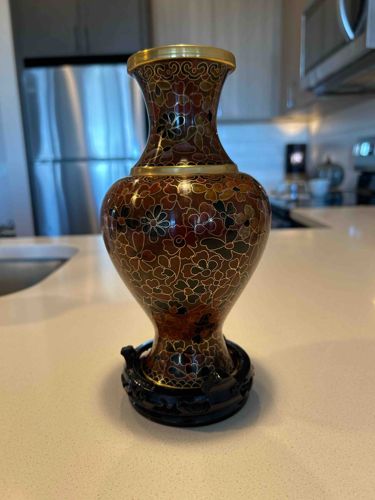
This is a classical Chinese cloisonné vase, characterized by its intricate enamel work. The vase features a traditional baluster shape, narrowing at the neck and base, with a wider body. It appears to be made of copper or brass, serving as the base for the cloisonné technique. The primary colors of the enamel work are rich, deep tones of reddish-brown and dark green, interspersed with black and lighter shades, forming a dense overall floral pattern. The outlines of the floral motifs and scrolling patterns are defined by fine brass or gilded wire, which is typical of cloisonné. The rim of the mouth and a band around the upper body, just below the neck, are finished with polished brass or gilded metal, showing a bright, reflective golden hue. The base of the vase also has a similar golden band where it meets the stand. The manufacturing technique suggests meticulous handcraftsmanship, involving the intricate bending of wires to form compartments, which are then filled with colored enamel paste and fired. No obvious condition issues such as cracks, chips, or significant losses to the enamel are visible from the provided images, indicating good preservation. There might be some minor surface wear or patina commensurate with age on the metal components. The vase rests upon a separate, elaborately carved black wooden stand. The stand has a circular base with raised, stylized feet or scrolling elements, designed to cradle the rounded base of the vase securely. The carving work on the stand appears detailed and traditional, typical of Asian artistry. Without maker's marks, estimation of age is challenging, but the style generally aligns with 20th-century Chinese decorative arts. The quality of the wirework and enamel filling appears consistent and well-executed, indicative of a good quality decorative piece.
AI Appraisal Report
Upon visual examination of the provided image, I assess this Chinese Cloisonné Vase with Floral Motif on Carved Wooden Stand to be a good quality decorative art piece. The classical baluster form, intricate floral and scrolling patterns, and the definition provided by fine brass wirework are characteristic of traditional Chinese cloisonné. The enamel work shows rich, deep tones with no obvious chips, cracks, or significant losses, indicating good preservation. The brass or gilded metal components, such as the rim and banding, appear bright; any minor surface wear or patina would be commensurate with age. The accompanying elaborately carved black wooden stand enhances the presentation of the vase. The overall manufacturing technique suggests meticulous handcraftsmanship, typical of 20th-century Chinese decorative arts.
Market conditions for good quality, unsigned cloisonné vases of this period are generally stable. Comparable pieces of similar size and craftsmanship have consistently sold within the $350-$650 range at auction and retail. Demand for decorative Chinese cloisonné remains consistent, though this specific piece is not exceptionally rare without unique stylistic elements or a recognized maker. The quality of the wirework and enamel filling, appearing consistent and well-executed, is a significant factor impacting its value positively.
However, it is crucial to note the limitations of authenticity verification from images alone. Without a physical inspection, I cannot account for hidden condition issues, the actual material composition beyond a base metal, or the true age. An in-person examination would allow me to feel the texture of the enamel, examine the underside for any markings (which are currently not visible), assess the weight, and scrutinize the internal condition of the vase. Provenance documentation, if available, could significantly enhance the appraisal, especially if it points to a known workshop or specific historical period. Scientific testing (such as XRF analysis for metals) would be required for a definitive material and age assessment, particularly for dating prior to the 20th century.