AI estimate as of August 16, 2025 · verify with a professional before acting
AI-Generated · Verify before acting
Everything on this page is generated by AI for informational purposes only. AI can make mistakes — the AI may misidentify items or misattribute them (artist, maker, brand, designer, origin, era). This is not an official valuation and should not be used for insurance, sale, tax, estate, legal, or lending purposes — or any decision requiring a certified appraisal. It is not an authoritative claim about any person, brand, or rights holder — do not share or rely on it as a factual statement about a third party. Always consult qualified professionals before making financial decisions.
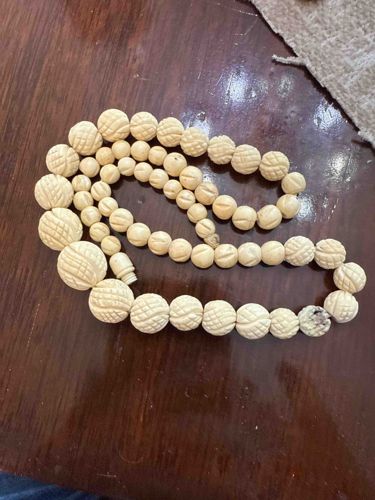
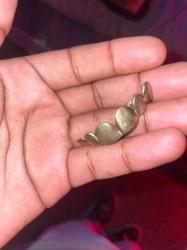
This item is a string of beads, likely forming a necklace or prayer beads (such as a tasbih/misbaha or mala). The beads are carved from a light-colored material, possibly bone, ivory, resin, or a similar organic substance, exhibiting a creamy off-white to very light yellow hue. The overall length of the string is not fully discernible, but it appears to be substantial given the number of beads present. There is a clear graduation in bead size, with larger, more ornate beads at one end, transitioning to smaller, simpler beads. The largest beads, concentrated at one end, feature intricate carved patterns, primarily a cross-hatched or basket-weave motif, providing a textured surface. Some smaller beads also show similar carving, while others are smooth or have simpler incised lines. One bead near the large, carved ones appears to be a 'leader' bead or 'imam' bead, typical of prayer beads, marked by its elongated, tapered shape and possibly the drilling for the string's termination. The craftsmanship appears to be hand-carved, with slight irregularities in the carving patterns and bead shapes indicative of manual work rather than mass machine production. The beads are strung on a thin, likely waxed cord or similar material. Visible condition issues include some darkening or discoloration on a few beads, particularly one smaller bead which has a distinct dark grey/black spot, possibly indicative of wear, dirt accumulation, or inherent material imperfections/inclusion. There is also a slight patination visible on some surfaces, lending to the aged appearance of the piece. The overall quality suggests a artisanal piece.
AI Appraisal Report
I have examined the image of this Graduated Carved Bead Strand. The beads, appearing to be crafted from a light-colored, organic material (possibly bone or an early resin), exhibit a creamy off-white to very light yellow hue. The clear graduation in bead size, from large ornate pieces with intricate cross-hatched carving to smaller, simpler ones, is notable. One elongated, tapered bead suggests a 'leader' or 'imam' bead, typical of prayer strands. The craftsmanship appears hand-carved, evidenced by slight irregularities, indicating artisanal work over machine production.
In terms of condition, there is a visible patination consistent with age and some discoloration, notably a dark spot on one bead, which could be wear, dirt, or an inherent material inclusion. These do not significantly detract from its aesthetic appeal, rather lending to its vintage character.
Authenticity from images alone is challenging. While the appearance suggests an older, hand-carved piece, definitive material identification (bone, ivory, resin) and age verification would require in-person examination, including tactile assessment, microscopic analysis, and potentially spectrographic testing. Provenance documentation would also be crucial. If verified as antique bone or ivory, this would significantly increase value; if modern resin, the value would be considerably lower.
Market conditions for hand-carved spiritual or decorative bead strands vary widely based on material, age, origin, and artistic merit. Given the perceived artisanal quality and potential age, this piece could appeal to collectors of ethnic jewelry, prayer beads, or folk art. Comparables would range from simple bone beads to more elaborate antique strands. Without definitive material and age confirmation, the demand is speculative.
Factors significantly impacting value are the actual material of the beads (bone commands more than resin, antique bone more than new), the age of the piece, and its origin. Rarity would hinge on the intricacy of the carving and the overall condition for its age. My appraisal assumes it is an older, hand-carved piece of organic material, likely bone or a dense resin, but not antique ivory without further testing.
Limitations: I cannot definitively confirm the material (bone, ivory, resin) or precise age from images. This requires physical inspection and scientific testing.