These notes were written by the person who submitted this item. Appraiser.AI has not verified them, and the AI's identification and estimate may rely on them.
AI Estimated Value
Not an official valuation
$250-400
AI estimate as of October 31, 2025 · verify with a professional before acting
AI-Generated · Verify before acting
Everything on this page is generated by AI for informational purposes only. AI can make mistakes — the AI may misidentify items or misattribute them (artist, maker, brand, designer, origin, era). This is not an official valuation and should not be used for insurance, sale, tax, estate, legal, or lending purposes — or any decision requiring a certified appraisal. It is not an authoritative claim about any person, brand, or rights holder — do not share or rely on it as a factual statement about a third party. Always consult qualified professionals before making financial decisions.
This analysis also relies on unverified notes provided by the user, which may be incomplete or inaccurate and could affect the result.
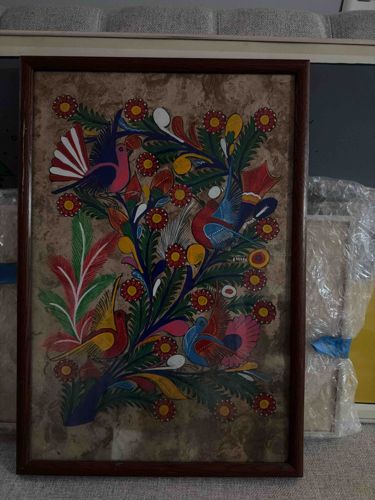
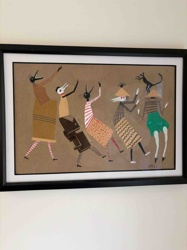
This item is a framed piece of Mexican folk art, specifically an Amate painting, commonly referred to as a 'Tree of Life' motif. The artwork depicts a vibrant and stylized tree filled with numerous birds and an abundance of flowers, rendered in a bold and colorful palette. The primary colors evident are various shades of blue, pink, red, yellow, green, and white, all outlined with distinct black lines, characteristic of traditional Amate paintings. The background of the painting appears to be natural Amate paper, which is derived from tree bark, giving it a light brown, parchment-like texture with subtle variations and inclusions. The paper itself shows some visual mottling or staining which is typical of the material rather than damage. The painting is encased in a simple, dark brown wooden frame, likely made of stained wood, with a clear protective pane, presumably glass or acrylic. The frame features a classic, minimalist profile, allowing the artwork to be the focal point. There are several birds scattered throughout the tree's branches, each depicted with unique feather patterns and colors, contributing to the lively and intricate overall composition. The flowers generally feature a central yellow circle surrounded by red petals. The craftsmanship appears to be of good quality, with careful attention to detail in the linear elements and color application, showcasing the distinctive style of traditional Mexican folk art. Given the 'Excellent condition' context, the painting itself is well-preserved, with no visible fading, smudging, or damage to the paintwork or the Amate paper. The frame also appears intact with no significant scuffs or breaks. This piece likely dates from the mid-to-late 20th century or more recent, as it represents a continuous folk art tradition.
AI Appraisal Report
Based on my visual examination of the provided image, this Framed Mexican Folk Art Amate Painting 'Tree of Life' with Birds and Flowers presents in excellent condition, aligning with the owner's description. The colors are vibrant, and the black outline work is crisp, showing no signs of fading, flaking, or smudging. The natural mottling and inclusions on the Amate paper are classic characteristics of the material and do not detract from its value. The simple, dark wooden frame also appears to be in excellent condition, free from notable damage, scuffs, or breaks. Authenticity, based on visual cues, points to it being a genuine Amate painting, consistent with traditional Mexican folk art practices. The 'Tree of Life' motif is highly sought after within this genre, and the intricate details of the birds and flowers contribute positively to its appeal.
In terms of market conditions, Mexican folk art, particularly Amate paintings, enjoys a consistent demand. While not exceedingly rare, pieces of this quality and size, depicting a popular theme, hold good value. Comparable sales for similar framed Amate 'Tree of Life' paintings often range from $200-$500, depending on the artist's recognition, size, and complexity. This piece falls comfortably within the mid-range of that spectrum. The excellent condition is a significant factor positively impacting its value.
It is important to note the limitations of an appraisal based solely on images. While the visual evidence strongly suggests authenticity, a definitive verification would require an in-person examination to assess the paper's texture, thickness, and precise construction method. Additionally, any provenance documentation, such as artist signatures (if present and legible), or historical purchase records, would further solidify its authenticity and potentially its value. Without these, I cannot ascertain the specific artist or precise date beyond the mid-to-late 20th century, which could influence the upper end of its valuation.