AI estimate as of August 25, 2025 · verify with a professional before acting
AI-Generated · Verify before acting
Everything on this page is generated by AI for informational purposes only. AI can make mistakes — the AI may misidentify items or misattribute them (artist, maker, brand, designer, origin, era). This is not an official valuation and should not be used for insurance, sale, tax, estate, legal, or lending purposes — or any decision requiring a certified appraisal. It is not an authoritative claim about any person, brand, or rights holder — do not share or rely on it as a factual statement about a third party. Always consult qualified professionals before making financial decisions.
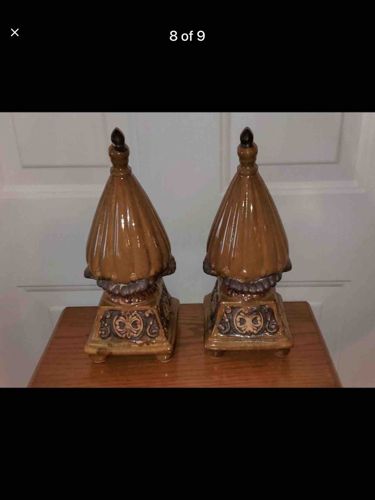
This is a pair of decorative ceramic or pottery finials or architectural elements, likely intended for display on a mantelpiece, shelf, or as part of a larger decorative scheme. Each item features a distinct, multi-part construction. The dominant upper section is conical or bell-shaped, characterized by a series of vertical fluted or pleated indentations, finished with a glossy, medium-brown glaze that suggests a wood-grain or caramelized effect. At the very top of each finial is a small, dark, bulbous element, possibly a dark stained wood or dark glazed ceramic component, acting as an accent or handle. Below the main conical body, there is a band of darker, possibly grayish-blue or plum-colored material, which appears textured or ruffled, providing a visual separation from the base. The base itself is quadrilateral, wider than it is tall, and features ornate, raised scrollwork or foliate patterns in a darker brown or black glaze over a lighter, mottled brown background. The craftsmanship appears to be reasonably good, with clear molding and detailing on the bases. There are no obvious signs of significant damage such as chips or cracks visible from this angle, though the lighting and resolution limit a definitive assessment of condition issues like crazing or minor abrasions. The glossy finish is consistent across both pieces, indicating they are a matched set. The overall style suggests a traditional, possibly Victorian or early 20th-century aesthetic, though such designs can be replicated in more contemporary periods. Their robust appearance indicates they are made from a solid material, likely ceramic or stoneware rather than a lighter resin.
AI Appraisal Report
I have carefully examined the image of this pair of decorative ceramic finials. Visually, their condition appears good; I see no obvious chips, cracks, or significant abrasions from this perspective. The glossy glazes are consistent, suggesting they are a well-matched set, which enhances their appeal as a decorative pair. The craftsmanship, particularly the clear molding and detailing on the bases, indicates a decent quality of manufacture. The style, with its fluted conical forms and ornate bases, strongly suggests a traditional aesthetic, potentially late Victorian to early 20th century. However, without tactile examination, I cannot conclusively rule out later reproductions. Their robust appearance implies they are solid ceramic or stoneware, contributing to their perceived quality.
Market conditions for decorative ceramic finials of this nature are generally stable but not exceptionally strong unless attributed to a renowned maker or specific period. Comparable items, often found in antique shops or online marketplaces, typically fall within a modest price range. Demand for such pieces is moderate, appealing primarily to collectors of period décor or those seeking unique accent pieces. While not extremely rare, finding a well-preserved matched pair is less common than single finials, adding to their desirability. Factors impacting value include their presumed age, a complete lack of damage, and their status as a pair. I cannot, however, definitively assess minor imperfections like crazing without an in-person inspection. For full authenticity verification, I would need to physically examine the items for manufacturing marks, assess the clay body and glazes under magnification, and ideally review provenance documentation. Scientific testing, such as thermoluminescence dating, could confirm age but would likely be cost-prohibitive for items in this value range.