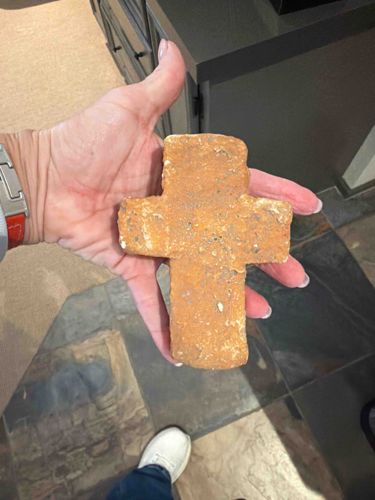
Hand-forged Cross-Shaped Clay Brick
Religious Artifacts / Architectural Salvage

Hand-forged Cross-Shaped Clay Brick

This unique object is a rustic, hand-molded cruciform artifact constructed from fired clay or terracotta. Based on the scale provided by the human hand holding it, the item measures approximately 6 inches in height and 4 inches in width. The material is a coarse, earthenware clay with a warm, reddish-orange or ochre hue, characteristic of high iron content common in regional clays. Its surface is highly textured and irregular, showing significant inclusions of grit, sand, and possibly small pebbles, indicating it was likely field-formed rather than industrially produced. The edges are rounded and uneven, suggesting hand-modeling rather than the use of a precise mold. The thickness appears to be roughly one inch, giving it a heavy, substantial feel. There are visible signs of weathering and material loss, particularly at the corners and along the edges, resulting in a naturally distressed patina. No discernible maker's marks, signatures, or stamps are visible on the primary face. This piece likely dates to the late 19th or early 20th century, possibly intended as a grave marker, a decorative element for a religious building, or a folk-art votive object. Its primitive craftsmanship and organic form lend it a distinctive, soulful aesthetic frequently sought in vernacular antiques and architectural salvage.
Estimated Value

$150-$300

Basic Information

Category

Religious Artifacts / Architectural Salvage

Appraised On

March 2, 2026

Estimated Value

$150-$300

Item Description

This unique object is a rustic, hand-molded cruciform artifact constructed from fired clay or terracotta. Based on the scale provided by the human hand holding it, the item measures approximately 6 inches in height and 4 inches in width. The material is a coarse, earthenware clay with a warm, reddish-orange or ochre hue, characteristic of high iron content common in regional clays. Its surface is highly textured and irregular, showing significant inclusions of grit, sand, and possibly small pebbles, indicating it was likely field-formed rather than industrially produced. The edges are rounded and uneven, suggesting hand-modeling rather than the use of a precise mold. The thickness appears to be roughly one inch, giving it a heavy, substantial feel. There are visible signs of weathering and material loss, particularly at the corners and along the edges, resulting in a naturally distressed patina. No discernible maker's marks, signatures, or stamps are visible on the primary face. This piece likely dates to the late 19th or early 20th century, possibly intended as a grave marker, a decorative element for a religious building, or a folk-art votive object. Its primitive craftsmanship and organic form lend it a distinctive, soulful aesthetic frequently sought in vernacular antiques and architectural salvage.
Get Your Items Appraised

Instant estimates of your treasures with AI-powered instant appraisals

Browse More Appraisals