These notes were written by the person who submitted this item. Appraiser.AI has not verified them, and the AI's identification and estimate may rely on them.
AI Estimated Value
Not an official valuation
$400-$700
AI estimate as of September 14, 2026 · verify with a professional before acting
AI-Generated · Verify before acting
Everything on this page is generated by AI for informational purposes only. AI can make mistakes — the AI may misidentify items or misattribute them (artist, maker, brand, designer, origin, era). This is not an official valuation and should not be used for insurance, sale, tax, estate, legal, or lending purposes — or any decision requiring a certified appraisal. It is not an authoritative claim about any person, brand, or rights holder — do not share or rely on it as a factual statement about a third party. Always consult qualified professionals before making financial decisions.
This analysis also relies on unverified notes provided by the user, which may be incomplete or inaccurate and could affect the result.
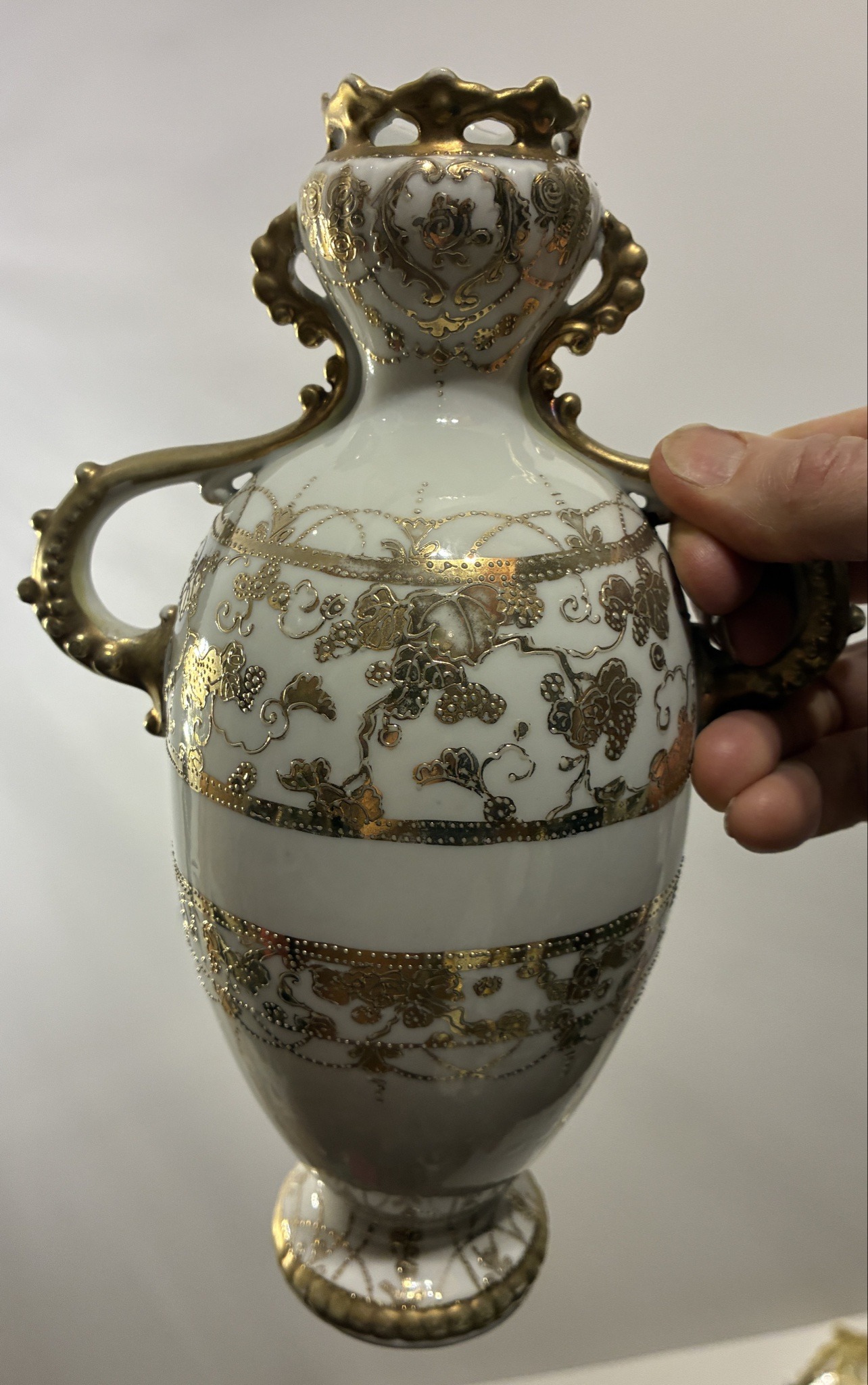
This is a decorative, two-handled porcelain urn-form vase featuring elaborate gilt ornamentation over a white glazed ceramic body. The item stands approximately 26 cm tall, as noted in unverified user claims, and is held by a hand in the photograph for scale. The vase features a flared, lobed rim heavily accented with gilded details, a constricted neck with raised scrollwork, two ornate looping handles extending from the shoulder to the upper neck, an oviform body, and a circular footed base. The surface is richly decorated with raised and flat gilding, incorporating floral motifs, scrolling patterns, beaded enamel accents known as jeweling, and intricate botanical or grapevine friezes bandings across the upper body and base. The white porcelain ground shows a glossy finish. There is no visible maker's mark on the exterior, and the owner notes that there is no mark on the base, leaving the manufacturing origin unauthenticated. The stylistic elements, particularly the heavy raised gilding, ornate rococo-revival handles, and elaborate patterning, are consistent with nineteenth-century or early twentieth-century European porcelain production, potentially originating from factories such as those in Limoges, Austria, or Germany, though this remains an unverified stylistic hypothesis rather than a confirmed fact. The overall craftsmanship displays a high level of decorative detail, though minor wear to the gilt surfaces can be expected due to age. The user-supplied context regarding the height and lack of base markings is unverified by physical inspection.
AI Appraisal Report
Based on what I can see in the photograph, this decorative, two-handled porcelain urn-form vase features elaborate gilt ornamentation and raised enamel jeweling on a white glazed ceramic body. I note the user-supplied claims that the vase stands approximately 26 cm tall and bears no maker's mark on the base. I can't verify these physical dimensions, the ceramic body's exact composition, or the absence of subtle factory stamps without an in-person physical inspection. Stylistically, the heavy raised gilding and rococo-revival handles suggest a potential nineteenth-century or early twentieth-century European origin, possibly consistent with production centers such as Limoges, Austria, or Germany. However, stylistic elements alone remain a working hypothesis rather than a confirmed identification. The value estimate of $400 to $700 assumes that the piece is a period European porcelain production item from the late nineteenth or early twentieth century in good condition, allowing for minor wear to the gilt surfaces. General market demand for decorative nineteenth-century style porcelain urns tends to be modest, with buyers favoring well-preserved aesthetic appeal. To move toward confirming authenticity or manufacturing origin, one would need a physical inspection by a ceramics expert, detailed hallmark verification, and careful examination of the glaze and paste under magnification. If this item were to turn out to be a later reproduction, modern copy, or manufactured 'in the style of' a period piece without actual vintage age, the market value would typically decrease significantly, likely falling into the $100 to $250 range depending on decorative quality.