These notes were written by the person who submitted this item. Appraiser.AI has not verified them, and the AI's identification and estimate may rely on them.
AI Estimated Value
Not an official valuation
$25 - $45
AI estimate as of October 24, 2025 · verify with a professional before acting
AI-Generated · Verify before acting
Everything on this page is generated by AI for informational purposes only. AI can make mistakes — the AI may misidentify items or misattribute them (artist, maker, brand, designer, origin, era). This is not an official valuation and should not be used for insurance, sale, tax, estate, legal, or lending purposes — or any decision requiring a certified appraisal. It is not an authoritative claim about any person, brand, or rights holder — do not share or rely on it as a factual statement about a third party. Always consult qualified professionals before making financial decisions.
This analysis also relies on unverified notes provided by the user, which may be incomplete or inaccurate and could affect the result.
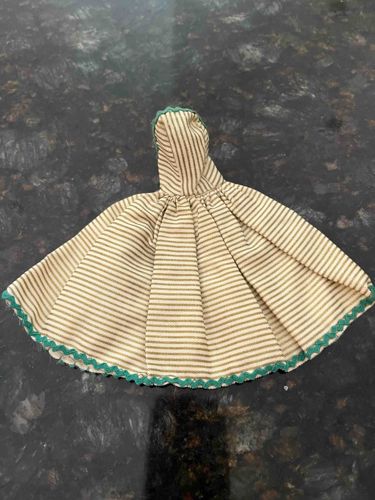
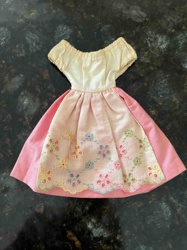
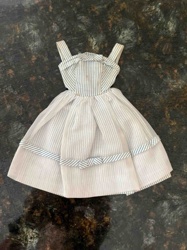
This item is a vintage doll garment, specifically a cloak or capelet designed likely for a fashion doll such as Barbie, consistent with the 1960s era as suggested by the prompt, though it is not a 'strapless dress.' The garment is constructed from a lightweight fabric, possibly cotton or a cotton blend, featuring a distinctive pattern of thin, horizontal stripes in two colors: an off-white or cream base with narrow brown or olive-green stripes. The fabric appears to be tightly woven. The garment has a fully gathered neckline, forming a small hood that could potentially fit over a doll's head. The capelet itself flares out from the neckline, creating a circular or bell-shaped silhouette when laid flat. A prominent and aesthetically pleasing feature is the trim along the entire lower hem and around the hood opening, which consists of a vibrant, scalloped green crochet or knitted edge. This trim adds a touch of color and intricate detailing. The stitching appears neat and consistent, suggesting good craftsmanship despite its small scale for a doll's accessory. There are no visible manufacturer's marks or tags, which is common for doll clothing of this age. The item appears to be in good vintage condition with no obvious tears, stains, or significant fraying. The colors of the fabric and the trim remain relatively vibrant, indicating proper storage or minimal exposure to harsh elements. The style, with its simple yet elegant lines and use of a hood, points to a period when doll clothing mimicked contemporary fashion trends or imaginative playwear.
AI Appraisal Report
I have examined the provided image of a vintage doll cloak/capelet with a hood. Based on the visual evidence, the garment appears to be a well-preserved piece of doll clothing, consistent with 1960s fashion doll accessories. The fabric, described as a lightweight, striped material (off-white/cream with brown/olive-green stripes), and the vibrant, scalloped green crochet trim are in good vintage condition, showing no apparent tears, prominent stains, or significant fraying. Colors retain their vibrancy, suggesting good care or minimal exposure to degrading elements. The stitching appears neat, indicative of good craftsmanship.
While the owner referred to it as a '1960’s strapless Barbie doll dress,' my visual assessment clearly identifies it as a hooded cloak or capelet. This distinction is crucial for accurate valuation. Authentic Barbie clothing from the 1960s often had specific tags for identification; the absence of such marks is typical for smaller accessories or handmade items, which this could be.
Market comparables for standalone vintage Barbie clothing accessories, particularly those without defined 'Mod' era flair or direct association with a specific, highly collectible original outfit, typically fall within a modest range. The unique striped pattern and the charming crochet trim add to its appeal. Demand for such unbranded doll accessories is moderate for collectors looking to complete outfits or enhance doll displays.
Factors impacting value include its good condition, appealing design, and potential fit for vintage Barbie or similar fashion dolls. Without definitive branding, its direct connection to genuine Mattel Barbie productions cannot be confirmed solely from the image. Rarity is difficult to assess without knowing its origin—whether it’s a factory piece, a regional variation, or a well-made custom item.
To fully authenticate this item, an in-person examination would be critical. This would allow for tactile assessment of the fabric composition, inspection of stitch quality, and a thorough search for any hidden maker's marks, as well as comparison to known vintage Barbie garment construction techniques. Provenance documentation, if available, would significantly enhance its verifiable authenticity.