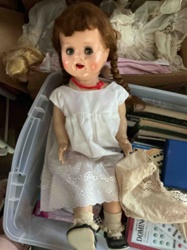
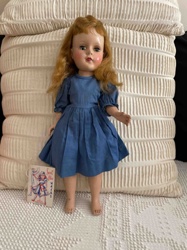
Bisque 1800. Dolls with right shoe missing on lower bisque legs. Original clothing with pantaloons underneath.
These notes were written by the person who submitted this item. Appraiser.AI has not verified them, and the AI's identification and estimate may rely on them.
AI Estimated Value
Not an official valuation
$600 - $900
AI estimate as of August 7, 2025 · verify with a professional before acting
AI-Generated · Verify before acting
Everything on this page is generated by AI for informational purposes only. AI can make mistakes — the AI may misidentify items or misattribute them (artist, maker, brand, designer, origin, era). This is not an official valuation and should not be used for insurance, sale, tax, estate, legal, or lending purposes — or any decision requiring a certified appraisal. It is not an authoritative claim about any person, brand, or rights holder — do not share or rely on it as a factual statement about a third party. Always consult qualified professionals before making financial decisions.
This analysis also relies on unverified notes provided by the user, which may be incomplete or inaccurate and could affect the result.
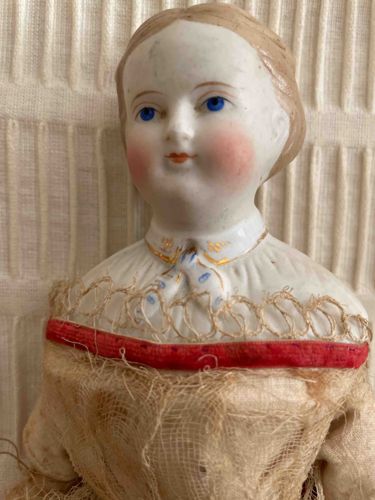
This is a bisque-headed doll, likely dating from the mid-to-late 19th century rather than the 1800s specifically, as true bisque technology for dolls became prevalent later in the century. The doll features a pale, smooth bisque head with hand-painted facial features. She has bright blue inset or painted eyes, a small red mouth with delicately painted lips, and distinctive rosy pink blush applied to her cheeks, indicating a youthful or childlike appearance. Her hair is molded and painted in a light brown or blonde shade, swept back from her forehead. The bisque shoulder plate is integrated with the head, with a clearly defined neckline. Around the neck of the bisque, there's a painted collar design in white with gold and blue accents, suggesting a decorative element of her original attire. The body appears to be cloth, covered in what seems to be original or very early clothing. The visible parts of the clothing include a finely woven, burlap-like material in a natural, light beige tone, which is significantly frayed and shows signs of age and wear. A prominent red ribbon or band is tied or sewn horizontally across the chest area of the doll's clothing, just below the bisque shoulder plate. Over this ribbon, there is a delicate, open-weave lace or crocheted trim in a natural fiber color, possibly cotton or linen, which is also showing signs of age and fragility. The doll is noted to have its original clothing, including pantaloons underneath, and is missing the right shoe on its lower bisque legs (not visible in the image but noted in context). The visible condition suggests significant age with wear and tear on the textile components, consistent with an antique item. The bisque head itself appears to be in relatively good condition, with no immediately visible chips or cracks from the provided image, though a full assessment would require more angles.
AI Appraisal Report
Upon examining the provided image and information, this bisque-headed doll presents as a genuine antique, likely from the mid-to-late 19th century, which aligns with the widespread adoption of bisque technology for dolls, rather than the earlier 1800s. The hand-painted features, particularly the rosy blush and delicate mouth, are characteristic of the period. The molded and painted hair, along with the integrated bisque shoulder plate and painted collar design, further supports its authenticity as a period piece.
Condition-wise, the bisque head appears to be in relatively good order, exhibiting no immediate signs of chips or cracks from the single image provided. This is a significant factor in its value. However, the textile components of the original clothing are heavily worn, frayed, and show considerable age, which is expected for an item of this vintage. While the presence of original clothing, including pantaloons, is a desirable trait, their condition detracts somewhat from the overall aesthetic appeal. The missing right shoe on the lower bisque legs (as noted) is a minor detraction but typical for dolls of this age.
Market conditions for antique bisque dolls are steady, with demand for well-preserved examples remaining consistent among collectors. Dolls with original clothing, despite wear, often command higher prices than those redresssed or significantly altered. The specific manufacturer, if identifiable through markings (not visible), could significantly impact value, as certain makers are highly sought after. However, lacking visible marks, this doll would likely be valued based on its generic antique appeal. Rarity is difficult to ascertain without more specific identification; however, dolls with painted bisque features are generally less common than those with glass eyes from the later 19th century.
Factors significantly impacting value include the excellent condition of the bisque head, the presence of original clothing (even with condition issues), and its overall aesthetic charm. The main detractions are the condition of the clothing and the missing shoe.
It is imperative to note the limitations of appraising from images alone. A full authentication would require an in-person examination to thoroughly inspect the bisque for hairline cracks, repairs, or touch-ups not visible in the photo. Physical inspection would also allow for examination of body composition, joint articulation, and any maker's marks on the head or body. Provenance documentation, such as original purchase records or family history, would significantly enhance value and authenticity. Scientific testing, while not typically applied to standard doll appraisals, could be used for material analysis if concerns arose about components.