AI Appraisal Estimate

AI-generated estimates · not official valuations

From the user

What was submitted

Photo and notes provided by the user — not generated by AI

Submitted item photo
Submitted photo · June 4, 2026

User's notes

No additional notes provided.

AI analysis below

AI appraisal

AI analysis & estimate

AI-Generated · Verify before acting

Everything below is generated by AI for informational purposes only. AI can make mistakes — the AI may misidentify items or misattribute them (artist, maker, brand, designer, origin, era). This is not an official valuation and should not be used for insurance, sale, tax, estate, legal, or lending purposes — or any decision requiring a certified appraisal. It is not an authoritative claim about any person, brand, or rights holder — do not share or rely on it as a factual statement about a third party. Always consult qualified professionals before making financial decisions.

Read the full disclaimer

AI Identification

·Not independently authenticated·Verify before acting

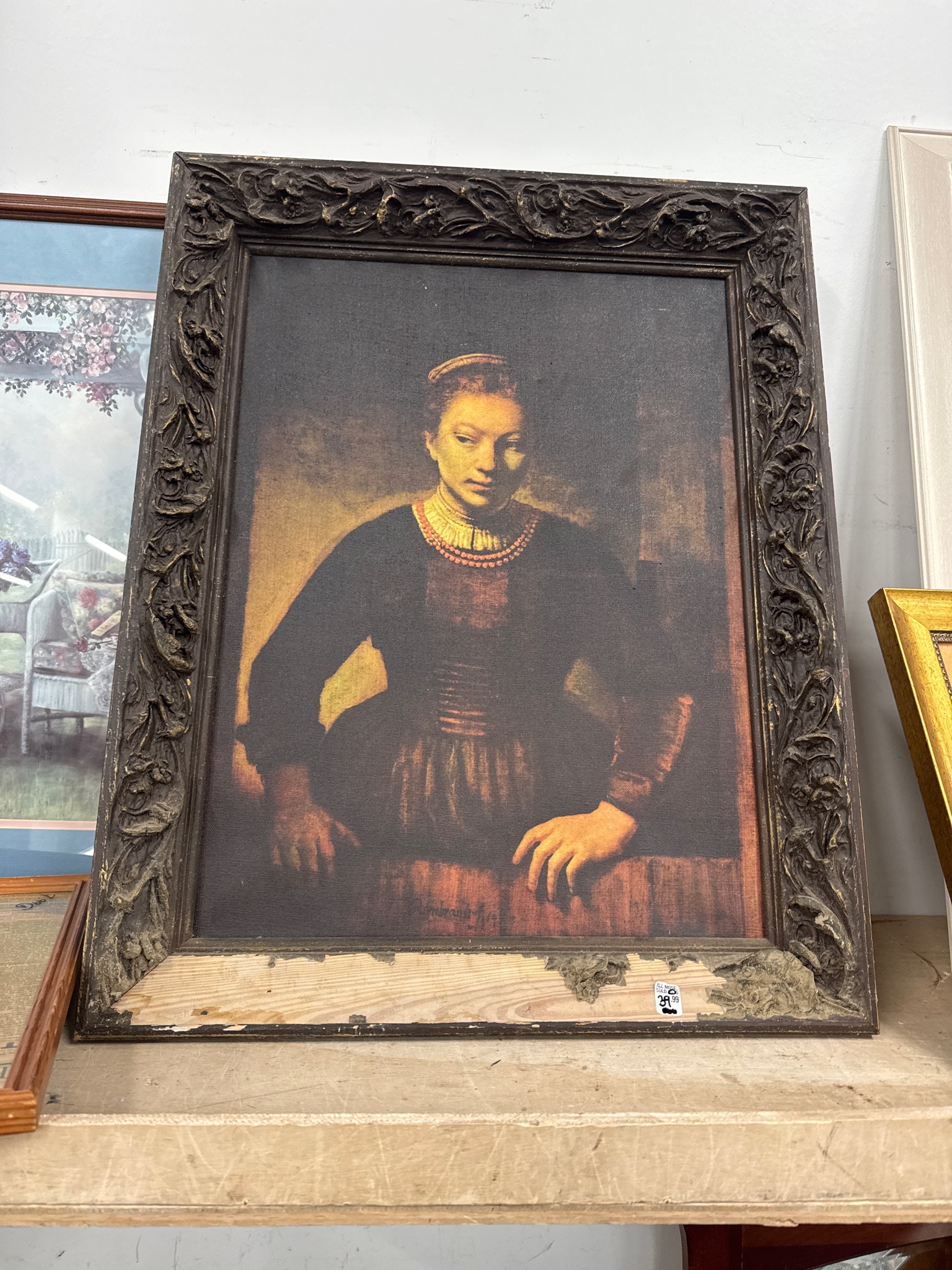
Framed Canvas Print of Rembrandt's 'A Young Woman Leaning on a Window Sill'

Wall Art & Decorative Prints

AI Estimated Value

·Not an official valuation·Verify before acting

$40 - $75

As of June 4, 2026

AI Item Analysis

·AI can make mistakes·Verify before acting
This item is a modern reproduction on canvas of the 1645 portrait 'A Young Woman Leaning on a Window Sill' (also known as 'The Kitchen Maid') by the Dutch Master Rembrandt van Rijn. The print features a rich, dark earth-tone palette dominated by deep ochres, umbers, and siennas, characteristic of the chiaroscuro style where the light source dramatically illuminates the subject's face, hands, and chest against a shadowy background. The canvas texture is clearly visible, indicating it is likely a mechanical lithographic or inkjet transfer onto canvas rather than an oil painting. It is house in a large, ornate Baroque-style composite frame with scrolled floral and acanthus leaf motifs. The frame appears to be made of wood or plaster over wood, finished in a dark, weathered bronze or 'antiqued' brown tone. Notable condition issues include significant damage to the bottom rail of the frame, where large sections of the decorative molding have broken off, revealing the raw, light-colored pine wood beneath. There is a price tag on the lower right of the inner frame lip. Despite the frame damage, the print surface appears intact but exhibits some dust and surface grime. The overall presentation suggests a mid-to-late 20th-century decorative mass-production piece designed to mimic an Old Master painting.


AI Appraisal Report

·AI can make mistakes·Verify before acting
I have conducted a visual appraisal of this framed canvas reproduction based on the provided details. The item is a modern decorative print of Rembrandt’s 1645 masterpiece 'A Young Woman Leaning on a Window Sill.' My examination confirms this is a mass-produced mechanical transfer (likely a lithograph or inkjet) rather than an original oil painting or a high-end hand-embellished giclée. The visible canvas grain and flat surface quality are hallmarks of mid-to-late 20th-century commercial home decor. The primary value driver for such pieces is typically the frame; however, this Baroque-style composite frame suffers from significant structural and aesthetic damage. The loss of molded ornamentation on the bottom rail, revealing the raw pine substrate, severely diminishes its 'ready-to-hang' appeal and decorative value. Market demand for damaged mass-market reproductions is currently low, as similar items in pristine condition are readily available at estate sales and thrift outlets for under $100. The appraisal reflects the cost of the substrate and a nominal value for a frame requiring professional restoration. Note: This assessment is based solely on digital representation. A physical inspection would be required to rule out more sophisticated printing techniques or to examine the frame's construction (wood vs. resin). While the subject matter is iconic, as a reproduction, it carries no rarity or investment value. Full authentication of any 'Rembrandt' subject requires provenance documentation and microscopic analysis of the paint layers to distinguish between a print and a historical copy; however, visual evidence here clearly points to a 20th-century commercial origin.

Get your items appraised

Instant estimates of your treasures with AI-powered appraisals

Browse More Appraisals