AI estimate as of November 2, 2025 · verify with a professional before acting
AI-Generated · Verify before acting
Everything on this page is generated by AI for informational purposes only. AI can make mistakes — the AI may misidentify items or misattribute them (artist, maker, brand, designer, origin, era). This is not an official valuation and should not be used for insurance, sale, tax, estate, legal, or lending purposes — or any decision requiring a certified appraisal. It is not an authoritative claim about any person, brand, or rights holder — do not share or rely on it as a factual statement about a third party. Always consult qualified professionals before making financial decisions.
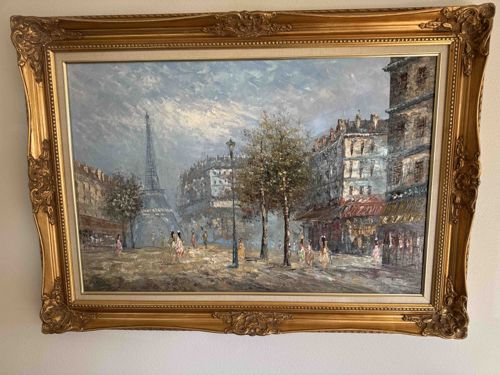
This item is an oil painting depicting a bustling Parisian street scene, rendered in an impressionistic style. The composition features a prominent view of the Eiffel Tower in the background, set against a light blue, cloudy sky. In the mid-ground, a tree-lined street is visible with several multi-story buildings, typical of Parisian architecture, lining the thoroughfare. Many of these buildings appear to have awnings over ground-floor establishments, suggesting shops or cafes. Numerous figures, depicted loosely with visible brushstrokes, populate the street, adding a sense of movement and life to the scene. A street lamp is also visible in the mid-ground. The colors are predominantly muted blues, grays, and browns, with touches of greens for foliage and warmer tones for figures and awnings, creating an overall soft and atmospheric effect characteristic of Impressionism. The paint application exhibits significant impasto, with thick, textured brushstrokes adding depth and dimension, particularly noticeable in the sky, trees, and foreground. The painting is housed in an ornate, gold-finished, possibly gilded, wooden frame. The frame features a classic Rococo-inspired design with decorative scrolling and floral motifs at the corners and along the inner and outer edges. The inner edge of the frame has a beaded pattern, and the outer edge has a more substantial, curved profile. The overall condition of the painting appears good from the image, with no obvious signs of significant damage, tears, or repairs visible. The frame also appears intact, with some possible minor wear consistent with its age. This style of painting, often featuring famous landmarks with lively street scenes, was popular from the late 19th through the 20th century, suggesting an estimated age from that period, likely mid-20th century or later given the commonality of such decorative pieces.
AI Appraisal Report
Based on my visual examination of the provided image, this Impressionistic Parisian Street Scene Painting with the Eiffel Tower appears to be in good overall condition. I observe no obvious tears, significant paint loss, or visible repairs to the canvas. The ornate, gold-finished frame also appears intact with some minor wear consistent with its age. The visible brushstrokes and impasto are characteristic of Impressionistic technique, and the subject matter, Parisian street scenes with landmarks, was (and remains) popular.
From the image alone, I assess this piece as a decorative oil painting, likely produced in the mid-20th century or later to capitalize on the enduring appeal of Parisian street scenes in an Impressionistic style. While the style mimics Impressionism, without a signature, artist information, or provenance, it's impossible to attribute it to a recognized artist from the core Impressionist movement. Market conditions for decorative landscape paintings of this nature are generally moderate. Comparables typically include unsigned or commercially produced canvases that evoke similar themes and styles.
Demand for such decorative pieces remains consistent, but rarity is low given the commonality of similar works. Key factors impacting value are the lack of artist identification, absence of provenance, and the likelihood of it being a mass-produced or studio piece rather than an original work by a named artist. The decorative frame adds some aesthetic value, but its monetary contribution is minimal.
To definitively verify authenticity, especially to rule out it being a signed work by a lesser-known artist or a period piece, an in-person examination is crucial. This would allow for closer inspection of brushwork, paint layers, canvas age, and any hidden signatures. Furthermore, provenance documentation (sales receipts, artist records) and potentially scientific testing (pigment analysis) would be essential to establish a reliable attribution and thereby a higher valuation. Without these, the appraisal reflects its value as a decorative artwork.