AI estimate as of November 11, 2025 · verify with a professional before acting
AI-Generated · Verify before acting
Everything on this page is generated by AI for informational purposes only. AI can make mistakes — the AI may misidentify items or misattribute them (artist, maker, brand, designer, origin, era). This is not an official valuation and should not be used for insurance, sale, tax, estate, legal, or lending purposes — or any decision requiring a certified appraisal. It is not an authoritative claim about any person, brand, or rights holder — do not share or rely on it as a factual statement about a third party. Always consult qualified professionals before making financial decisions.
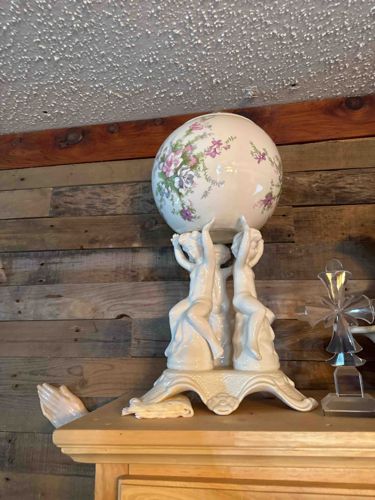
This item is a decorative porcelain or ceramic piece, likely functioning as a lamp base or a standalone artistic sculpture. It features a spherical globe adorned with a painted floral motif primarily in shades of purple and green, depicting what appear to be blossoming flowers and delicate foliage. The globe rests upon a sculptural stand crafted in the likeness of three cherubic figures, possibly nymphs or putti, each seemingly supporting the globe with their upraised arms. These figures display a classical influence in their sculpted forms, with draped garments and youthful features. The stand itself rests on a ornate, four-lobed base with a scalloped edge and raised decorative elements, suggesting a rococo or Baroque revival style. The entire piece appears to be made of a white-to-cream colored glazed ceramic or porcelain, giving it a luminous, smooth finish. No visible chips, cracks, or significant wear are immediately apparent from the provided images, indicating good to excellent preservation. The absence of visible wiring suggests it might be a decorative object rather than a functional lamp, or the wiring is concealed. Its overall aesthetic points to an early to mid-20th century production, though without specific maker's marks, a precise age is difficult to determine. The craftsmanship appears to be of good quality, with attention to detail in the sculpting of the figures and the clarity of the floral painting.
AI Appraisal Report
This porcelain floral globe with a cherub stand presents as a charming decorative art object. Visually, the condition appears good to excellent; I don't observe any overt chips, cracks, or significant wear in the provided images. The floral painting is vibrant, and the cherubic figures and ornate base maintain their detail, suggesting careful handling over time. Authenticity, based solely on visual examination, suggests it's a period piece from the early to mid-20th century, likely European in origin, possibly French or German. The style, with its rococo revival elements and hand-painted floral motifs, is consistent with that era.
Market conditions for such decorative porcelain pieces are stable, though not experiencing significant appreciation. Comparable items, often found in estate sales or online auctions, typically fetch prices in the mid-hundreds, particularly if unmarked. The demand is moderate, driven by collectors of decorative arts, those furnishing period interiors, or individuals seeking unique accent pieces. Rarity is not exceptionally high for unmarked pieces of this type, as similar items were produced by various manufacturers. Factors impacting value positively include the good condition and appealing aesthetic. However, the absence of a discernible maker's mark significantly limits its upper market potential, as provenance and artist identification are crucial for higher valuations.
Limitations in authenticity verification are substantial without physical inspection. To fully authenticate and attribute this piece, an in-person examination is critical to assess the porcelain quality, glazes, and painting technique in detail. The underside of the piece would need to be inspected for any hidden maker's marks, impressed numbers, or signature details. Furthermore, provenance documentation, such as original sales receipts or ownership history, would significantly enhance its value and confirm its age and origin. Scientific testing, like thermoluminescence dating for the porcelain, could definitively establish its age, though this is usually reserved for higher-value items where attribution is particularly contentious. Without these, the appraisal remains based on visual characteristics and general market trends for similar decorative porcelain.