AI estimate as of November 17, 2025 · verify with a professional before acting
AI-Generated · Verify before acting
Everything on this page is generated by AI for informational purposes only. AI can make mistakes — the AI may misidentify items or misattribute them (artist, maker, brand, designer, origin, era). This is not an official valuation and should not be used for insurance, sale, tax, estate, legal, or lending purposes — or any decision requiring a certified appraisal. It is not an authoritative claim about any person, brand, or rights holder — do not share or rely on it as a factual statement about a third party. Always consult qualified professionals before making financial decisions.
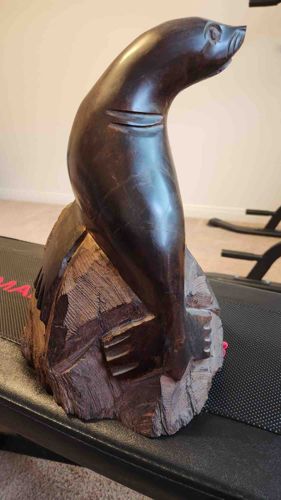
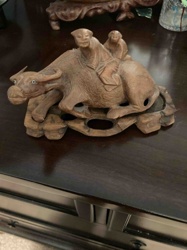
This is a dark-stained wooden sculpture depicting a sea lion, or perhaps a seal, in an upright, alert posture with its head turned slightly to the right. The overall piece measures approximately 15-20 inches in height based on its appearance when placed on what appears to be exercise equipment. The sea lion figure itself is rendered with smooth, polished curves, reflecting light and indicating a possible fine-grain wood or a rich finish. Its color is a deep, dark brown, almost black in some areas due to shadowing and the stain. Notable features include carved details for the eyes and snout, conveying a sense of sentience. Two horizontal incised lines are visible on the neck/shoulder area, which might represent folds in the skin or artistic styling. The sea lion is perched upon a base carved to resemble rocky terrain or a piece of driftwood. This base is also made of wood but has a much rougher, unpolished texture, with distinct tool marks and a lighter, reddish-brown hue visible, showcasing the natural wood grain and providing a strong contrast to the smooth animal figure. The craftsmanship appears to be hand-carved, with the rougher base suggesting a more rustic appeal, while the sea lion itself exhibits a higher degree of finishing and polish. No visible manufacturing marks or signatures are discernible from the provided images. The condition appears good, with no obvious major damage, cracks, or repairs, though some minor surface wear might be present on closer inspection. The style suggests a decorative, possibly folk art or oceanic theme, likely dating from the mid-to-late 20th century or early 21st century. The juxtaposition of smooth and rough textures is a unique characteristic, enhancing its visual interest.
AI Appraisal Report
Based on my visual examination of the provided image, I assess this carved wooden sea lion sculpture to be in good overall condition. There are no readily apparent major damages, cracks, or repairs. The smooth finish on the sea lion contrasts nicely with the rougher, rocky base, indicating good craftsmanship, likely hand-carved. The apparent height of 15-20 inches suggests a substantial decorative piece.
From a market perspective, comparable carved wooden animal sculptures, particularly those with a folk art or nautical theme, typically fall within a moderate price range. Pieces of this size and apparent quality, without a known artist or significant provenance, tend to have a niche but steady demand among collectors of marine-themed decor or hand-carved items. The juxtaposition of smooth and rough textures is a distinctive feature that enhances its appeal.
Factors impacting value include the lack of a discernible artist signature or manufacturer's mark, which limits its potential as a collectible artwork from a recognized creator. While attractive, it appears to be a decorative item rather than an antique with historical significance, limiting its upper market value.
It is important to note the limitations of image-based appraisal. Without a physical inspection, I cannot definitively verify the type of wood used, confirm the absence of subtle hairline cracks, minor chips, or surface wear, or ascertain the precise finishing techniques. In-person examination would allow for a tactile assessment of craftsmanship, detailed inspection for hidden repairs, and potentially reveal any faint markings. Provenance documentation, if available, correlating the piece to a specific artist or workshop, would significantly enhance authenticity and value, as would scientific analysis of the wood for dating purposes. Without these, authenticity is based solely on visual cues and general stylistic characteristics.