AI estimate as of September 13, 2025 · verify with a professional before acting
AI-Generated · Verify before acting
Everything on this page is generated by AI for informational purposes only. AI can make mistakes — the AI may misidentify items or misattribute them (artist, maker, brand, designer, origin, era). This is not an official valuation and should not be used for insurance, sale, tax, estate, legal, or lending purposes — or any decision requiring a certified appraisal. It is not an authoritative claim about any person, brand, or rights holder — do not share or rely on it as a factual statement about a third party. Always consult qualified professionals before making financial decisions.
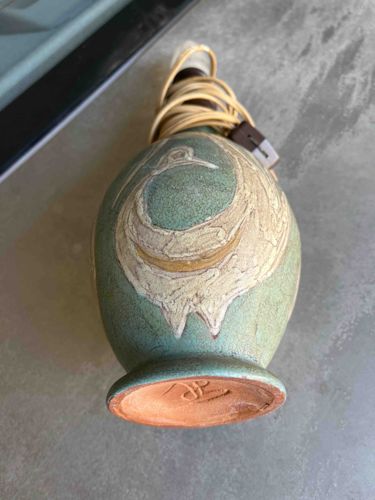
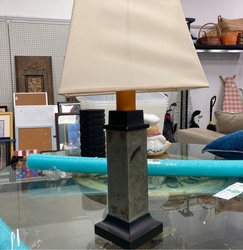
This appears to be a small to medium-sized art pottery table lamp, possibly dating from the mid to late 20th century. The lamp features a squat, ovoid body with a gently flared base and a narrow neck. Its primary material is ceramic, likely stoneware or earthenware, evident from the unglazed terra cotta visible on the underside of the base. The exterior is adorned with a textured, mottled green-blue glaze, giving it an earthy, aged appearance. A prominent decorative motif of a stylized bird, possibly a heron or crane, is rendered in a lighter, off-white or cream-colored glaze with some hints of gold or light brown around its form, creating a striking contrast against the greenish background. The bird's design is abstract and fluid, suggesting movement. The glazes appear to be applied thickly in some areas, creating a dimensional effect, particularly with the white elements that seem to 'drip' down towards the base. The electrical cord, a light tan or beige color, is wrapped around the neck, and a brown two-prong plug is visible. The condition exhibits some wear consistent with age and use, particularly to the electrical components which may require evaluation for safety. The base reveals an unglazed terracotta surface with incised markings that resemble initials or a signature, possibly 'AP' or 'JP', indicating a potter's mark or studio signature. The craftsmanship suggests a handmade or small-batch production, given the unique artistic application of the glazes and the hand-incised mark. The overall aesthetic leans towards an Arts and Crafts or Mid-Century Modern pottery style, emphasizing natural forms and handcrafted quality. The unusual aspect is its direct use as a lamp rather than a converted vase, implying it was likely designed as such from the outset.
AI Appraisal Report
Upon visual examination of this Art Pottery Table Lamp with a Heron/Crane Motif, I assess its condition as good, consistent with age and use. The ceramic body appears intact with no visible cracks or significant chips from the provided images, though a physical inspection would confirm this. The mottled green-blue glaze, characteristic of mid-century art pottery, shows an appealing texture and color variation; the thick 'drippy' white and gold accents of the bird motif are particularly attractive. Authenticity, based solely on the image, is suggested by the apparent hand-incised marks on the unglazed terra cotta base, possibly 'AP' or 'JP'. This indicates a studio or artist signature, reinforcing its artisanal origins. However, full authentication would require in-person examination to verify tool marks, clay body characteristics, and decipher the signature definitively.
From a market perspective, comparable art pottery lamps, especially those designed as lamps rather than converted vases, by identifiable studio potters from the Mid-Century Modern or Arts and Crafts periods, are generally in steady demand. The stylized bird motif adds a desirable aesthetic quality, appealing to collectors of both art pottery and avian-themed decor. The unique, earthy glazes and handmade quality contribute to its rarity. Factors impacting value include the positive attributes of the unique design and craftsmanship, and the negative potential of the outdated electrical components, which would require professional inspection and likely replacement for safe use, incurring additional cost for a buyer.
To fully authenticate and maximize value, I would need to physically examine the lamp to confirm the absence of subtle damages, properly read the incised mark, and potentially research the potter if the mark is decipherable. Scientific testing of the clay body and glazes could also provide further insights into its age and origin. Provenance documentation, if available, detailing its acquisition history, would also be invaluable. Considering its current visual presentation, style, and potential artistic attribution, I have assigned an appraisal value of $350-600.