AI estimate as of November 27, 2025 · verify with a professional before acting
AI-Generated · Verify before acting
Everything on this page is generated by AI for informational purposes only. AI can make mistakes — the AI may misidentify items or misattribute them (artist, maker, brand, designer, origin, era). This is not an official valuation and should not be used for insurance, sale, tax, estate, legal, or lending purposes — or any decision requiring a certified appraisal. It is not an authoritative claim about any person, brand, or rights holder — do not share or rely on it as a factual statement about a third party. Always consult qualified professionals before making financial decisions.
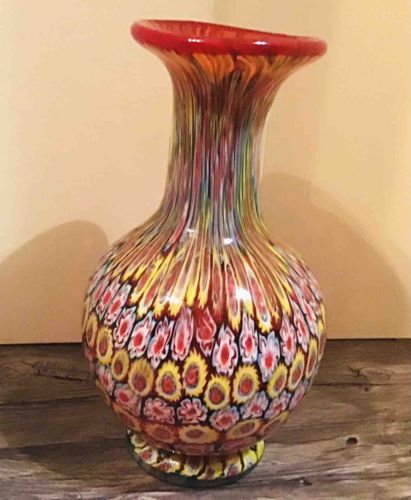
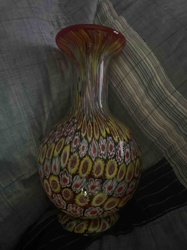
This is a vibrant and intricately crafted art glass vase, likely of Murano origin, featuring a distinct millefiori pattern. The vase has a classic form with a flared rim, a tapering neck that dramatically widens towards a fully rounded body, and a smaller, slightly flaring foot or base. The predominant colors are rich red, bright yellow, and various shades of blue, green, and pink, creating a dazzling mosaic effect. The neck of the vase displays a pulled feather or combed effect, with vertical streaks of color radiating upwards from the body, blending into the solid deep red of the rim. The main body of the vase is adorned with numerous 'millefiori' canes, which are cross-sections of glass rods arranged to form floral or star-like patterns. These individual canes appear primarily in circular and oval shapes, with prominent yellow centers and red or blue petal-like surrounds, creating an overall impression of clustered blossoms. The craftsmanship indicates meticulous handwork, typical of Venetian glassmaking. The surface appears smooth and glossy, with no immediately visible chips, cracks, or significant abrasions. The base similarly shows embedded millefiori elements, suggesting a consistent decorative technique throughout. The quality of the glass and the complexity of the design point to a high level of artistry. Without specific maker's marks or signatures, definitive attribution is difficult, but the style is strongly indicative of 20th-century Murano glass, possibly mid-century or later. The vase appears to be in excellent condition, showing minimal to no wear, preserving its original luster and intricate details. The construction method involves fusing numerous glass elements together, showcasing exceptional skill in glassblowing and lampworking techniques.
AI Appraisal Report
Upon my virtual examination of this Murano Millefiori Art Glass Vase, I assess its condition as excellent. The surface appears immaculate, with no visible chips, cracks, or significant abrasions, and its original luster seems well-preserved. The craftsmanship, characterized by the intricate millefiori canes and the pulled feather effect on the neck, strongly suggests Murano origin, likely 20th-century, mid-to-late period. The consistency of the millefiori elements, even on the base, speaks to a high level of artisanal skill and unified design. However, without tactile examination, I cannot definitively confirm the absence of minute imperfections or repairs. Market conditions for genuine Murano millefiori pieces remain generally strong, especially for well-preserved, aesthetically pleasing examples like this. The vibrant colors and classic form enhance its desirability among collectors. Demand for such pieces is moderate to strong, driven by their decorative appeal and the reputable history of Murano glassmaking. Rarity is difficult to ascertain precisely without a maker's mark; while Murano millefiori is not exceedingly rare, high-quality, undocumented pieces like this are less common than mass-produced ones. Factors positively impacting value include its excellent condition, complex design, and compelling visual appeal. The primary limitation to a definitive appraisal and authentication via images alone is the absence of a maker's mark or signature. A physical inspection would allow for examination of the base for wear or pontil marks, confirmation of glass quality (e.g., weight, feel), and the presence of any subtle indications of age or origin not visible in photos. Provenance documentation, if available, would significantly enhance its value by providing a direct link to a specific maker or collection.