AI estimate as of October 25, 2025 · verify with a professional before acting
AI-Generated · Verify before acting
Everything on this page is generated by AI for informational purposes only. AI can make mistakes — the AI may misidentify items or misattribute them (artist, maker, brand, designer, origin, era). This is not an official valuation and should not be used for insurance, sale, tax, estate, legal, or lending purposes — or any decision requiring a certified appraisal. It is not an authoritative claim about any person, brand, or rights holder — do not share or rely on it as a factual statement about a third party. Always consult qualified professionals before making financial decisions.
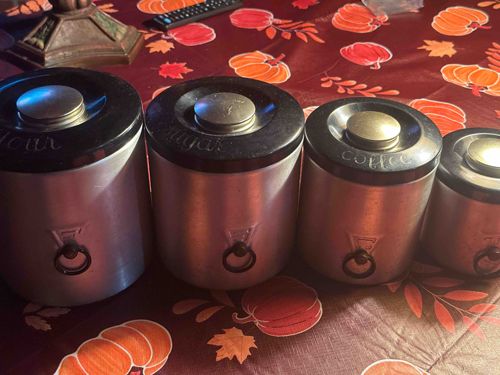
This is a set of three (a fourth is partially visible) vintage kitchen canisters, likely made of brushed aluminum with black plastic or Bakelite lids. Each canister is cylindrical in shape, with a slightly tapered body, presenting a classic, utilitarian design. The prominent physical characteristics include their metallic silver-grey finish, which exhibits some visible wear and minor surface abrasions consistent with age and use. The black lids have a recessed center, into which a brass-toned knob or handle is fitted, likely for opening. The words 'Flour', 'Sugar', and 'Coffee' are debossed or painted in a cursive script on the black lids, indicating their intended contents. On the front of each canister, below a stylized embossed detail, there is a small metal ring pull, attached via a small, bracket-like fixture. These ring pulls are black or dark-toned, possibly painted metal, and show some loss of finish or patina. The overall condition suggests regular use but no major damage such as dents, though the surfaces show typical scuffs and subtle discoloration. The brass-toned knobs on the lids also display some patina or wear on their finish. This style of canister set was popular from the mid-20th century, likely dating from the 1940s to 1960s, reflecting a mid-century modern or utilitarian aesthetic. The craftsmanship appears to be industrial standard for household goods of that era, valuing functionality and durability.
AI Appraisal Report
Upon examining the image, I've assessed this set of three (with a fourth partially visible) vintage aluminum kitchen canisters. Their design, with brushed aluminum bodies and black plastic/Bakelite lids featuring cursive lettering for 'Flour,' 'Sugar,' and 'Coffee,' strongly suggests a mid-20th-century origin, likely 1940s-1960s. The overall condition is consistent with regular use; I observe visible wear, surface abrasions, and some loss of finish on the black ring pulls and brass-toned lid knobs. While no major dents are apparent, typical scuffs and subtle discoloration are present, which is expected for items of this age and material. Their authenticity as period kitchenware appears robust from visual cues alone.
In terms of market conditions, vintage aluminum canister sets from this era are generally accessible. Comparables on online marketplaces and at antique shops typically range from $30 to $80, depending heavily on condition, completeness, and specific design elements. This set’s condition places it in the mid-range of that spectrum. While such items are not rare, a complete set in good displayable condition has steady demand from collectors of mid-century modern kitchenalia or those seeking a retro aesthetic. Factors impacting value include the number of canisters (this being a functional three with a fourth), the legibility of the lettering, and the absence of significant physical damage or corrosion. The black plastic lids, if Bakelite, could add a slight premium, but this is difficult to confirm without physical examination. I would recommend tactile inspection to confirm the lid material and to ascertain the exact extent of surface wear and patina. While the image provides a good overview, a physical inspection would fully verify authenticity, confirm material composition, and allow a more precise assessment of all surfaces for hidden damage or repairs, which could subtly adjust the final valuation.