AI estimate as of September 18, 2025 · verify with a professional before acting
AI-Generated · Verify before acting
Everything on this page is generated by AI for informational purposes only. AI can make mistakes — the AI may misidentify items or misattribute them (artist, maker, brand, designer, origin, era). This is not an official valuation and should not be used for insurance, sale, tax, estate, legal, or lending purposes — or any decision requiring a certified appraisal. It is not an authoritative claim about any person, brand, or rights holder — do not share or rely on it as a factual statement about a third party. Always consult qualified professionals before making financial decisions.
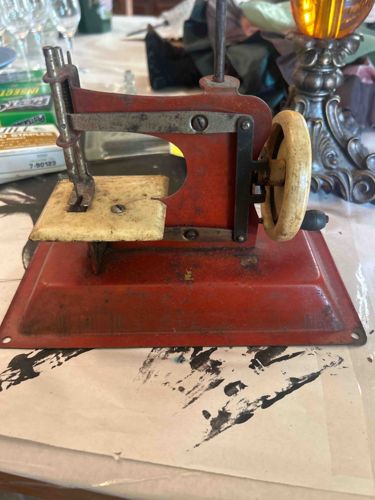
This appears to be a vintage children's toy sewing machine, likely constructed from a combination of painted cast iron or steel for the main body and possibly wood or a composite material for the handwheel and sewing plate. The primary color is a distressed, chipped red, indicating significant age and use. The base is also red, with a slightly raised border and visible mounting holes at the corners, suggesting it might have originally been affixed to another surface or a carrying case. The handwheel, located on the right side of the machine, is a light, cream or ivory color, showing signs of yellowing and wear. The sewing plate, where the 'fabric' would be placed, is also a similar light, aged cream color, made of what looks like bone, ivory, or a similar composite, and is attached with visible screws. The moving needle mechanism and presser foot assembly are made of unfinished or tarnished metal (steel or iron), exhibiting considerable oxidation and grime. The overall construction appears robust for a toy, suggesting it was designed to be functional, albeit simple. There are no clear manufacturer's marks or signatures visible in the provided images. The style and visible wear suggest an age possibly ranging from the early to mid-20th century, perhaps 1930s-1950s. The paint loss, rust on metal components, and general dirtiness contribute to a strong vintage or antique aesthetic, indicative of its age and history. The craftsmanship, while simple, seems sturdy for a toy of its era, using durable materials.
AI Appraisal Report
I have examined the provided image of this vintage children's toy sewing machine. Based on its appearance, it is likely constructed from painted cast iron or steel, with a distressed red finish. The handwheel and sewing plate appear to be made of a light composite material, possibly aged plastic, bone, or celluloid. The visible paint loss, surface rust on metal components, and general wear are consistent with an item from the early to mid-20th century, likely 1930s-1950s. The overall condition, while showing significant age and use, appears structurally sound for a toy of this type.
Authenticity is strongly suggested by the materials and construction, aligning with manufacturing practices of the era for robust children's toys. However, without a physical examination, I cannot definitively confirm the material composition of all parts, nor can I identify any manufacturer's marks which are not visible in the image. In-person inspection would allow for examination of internal mechanisms, verification of material composition, and a thorough assessment of any repairs or alterations.
Market conditions for vintage toy sewing machines are generally moderate. While there is a niche collector's market, non-branded, well-used examples like this typically do not command premium prices unless they are in exceptional condition or represent a particularly rare model. Comparables in similar condition often sell in the $50-$150 range. The lack of visible branding slightly devalues it, as branded models from companies like Singer, Casige, or Kenmore often fetch higher prices. The appeal lies primarily in its nostalgic and decorative value rather than its rarity.
Factors impacting value include its distressed but complete appearance, which many collectors appreciate as 'patina.' Conversely, the lack of a clear maker's mark and the absence of original packaging or accessories somewhat limit its top-end value. Given its condition and apparent age, I estimate its current market value to be between $60 and $120.