AI estimate as of August 11, 2025 · verify with a professional before acting
AI-Generated · Verify before acting
Everything on this page is generated by AI for informational purposes only. AI can make mistakes — the AI may misidentify items or misattribute them (artist, maker, brand, designer, origin, era). This is not an official valuation and should not be used for insurance, sale, tax, estate, legal, or lending purposes — or any decision requiring a certified appraisal. It is not an authoritative claim about any person, brand, or rights holder — do not share or rely on it as a factual statement about a third party. Always consult qualified professionals before making financial decisions.
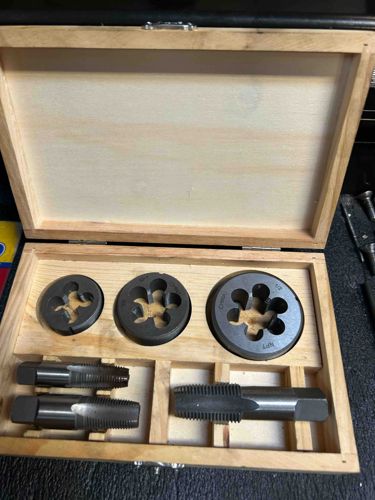
This appears to be a vintage or significantly used tap and die set housed in a simple, open-top wooden storage box. The box itself is made of light-colored wood, likely pine or similar, with visible grain patterns and what appear to be mitered or finger-jointed corners, indicative of basic but functional construction. The interior of the box features custom-cut wooden compartments designed to snugly fit the various components of the set, suggesting it was either purpose-built for these tools or modified to house them. The tools themselves consist of three dies (circular threaded cutters) of varying sizes, visibly dark gray or black in color, likely made of hardened steel. They show signs of use, including some wear and perhaps some residual grease or grime, contributing to a slight patina. One of the dies clearly shows the marking '1/2 NPT', indicating its threading specification. Below the dies are what appear to be three taps, which are tools used to cut or form the internal threads of a hole. These taps are also dark in color, ribbed for threading, and exhibit a worn, functional appearance. The surfaces of the tools show scuffs, minor scratches, and uneven coloration consistent with regular use and age. No specific maker's marks are clearly visible on the tools themselves beyond the threading specifications. The overall condition suggests a functional set that has been in use for some time, possibly several decades given the general wear patterns and the traditional wooden box packaging, which is less common for modern sets. The craftsmanship of the tools themselves seems robust and utilitarian.
AI Appraisal Report
Upon visual inspection of the provided image, this tap and die set in a wooden case appears to be a functional, vintage set. The box itself, while simple pine, suggests care in its purpose-built compartments, indicating it was intended for these specific tools or modified to house them. The tools show clear signs of use, including scuffs, scratches, and a patina consistent with age and regular work. The '1/2 NPT' marking confirms a common threading standard. The condition is "used" rather than "collectible pristine," which limits its value for pure display but confirms its functional integrity. There are no visible maker's marks, which prevents specific factory authentication or attributing it to a historically significant manufacturer that might increase its value. Market conditions for used, unbranded tap and die sets are generally moderate. While a new, quality set can be quite expensive, used sets typically fetch less unless they are from a highly sought-after vintage brand like Starrett or L.S. Starrett, or are exceptionally rare. This set, while robust, doesn't present as particularly rare. Its value is primarily functional. Demand exists from hobbyists, tradespeople, or those seeking an economical alternative to new sets. The lack of clear branding and the heavy signs of use are the primary factors limiting a higher appraisal. Without physical inspection, I cannot confirm the material integrity, the sharpness of the cutting edges, the absence of rust hidden by the patina, or the manufacturer. Full authentication would require in-person examination to check for hidden marks, assess metal quality, and determine the precise manufacturing era through component analysis. Provenance documentation could also significantly impact value if it linked the set to a notable individual or historical context.