AI estimate as of November 19, 2026 · verify with a professional before acting
AI-Generated · Verify before acting
Everything on this page is generated by AI for informational purposes only. AI can make mistakes — the AI may misidentify items or misattribute them (artist, maker, brand, designer, origin, era). This is not an official valuation and should not be used for insurance, sale, tax, estate, legal, or lending purposes — or any decision requiring a certified appraisal. It is not an authoritative claim about any person, brand, or rights holder — do not share or rely on it as a factual statement about a third party. Always consult qualified professionals before making financial decisions.
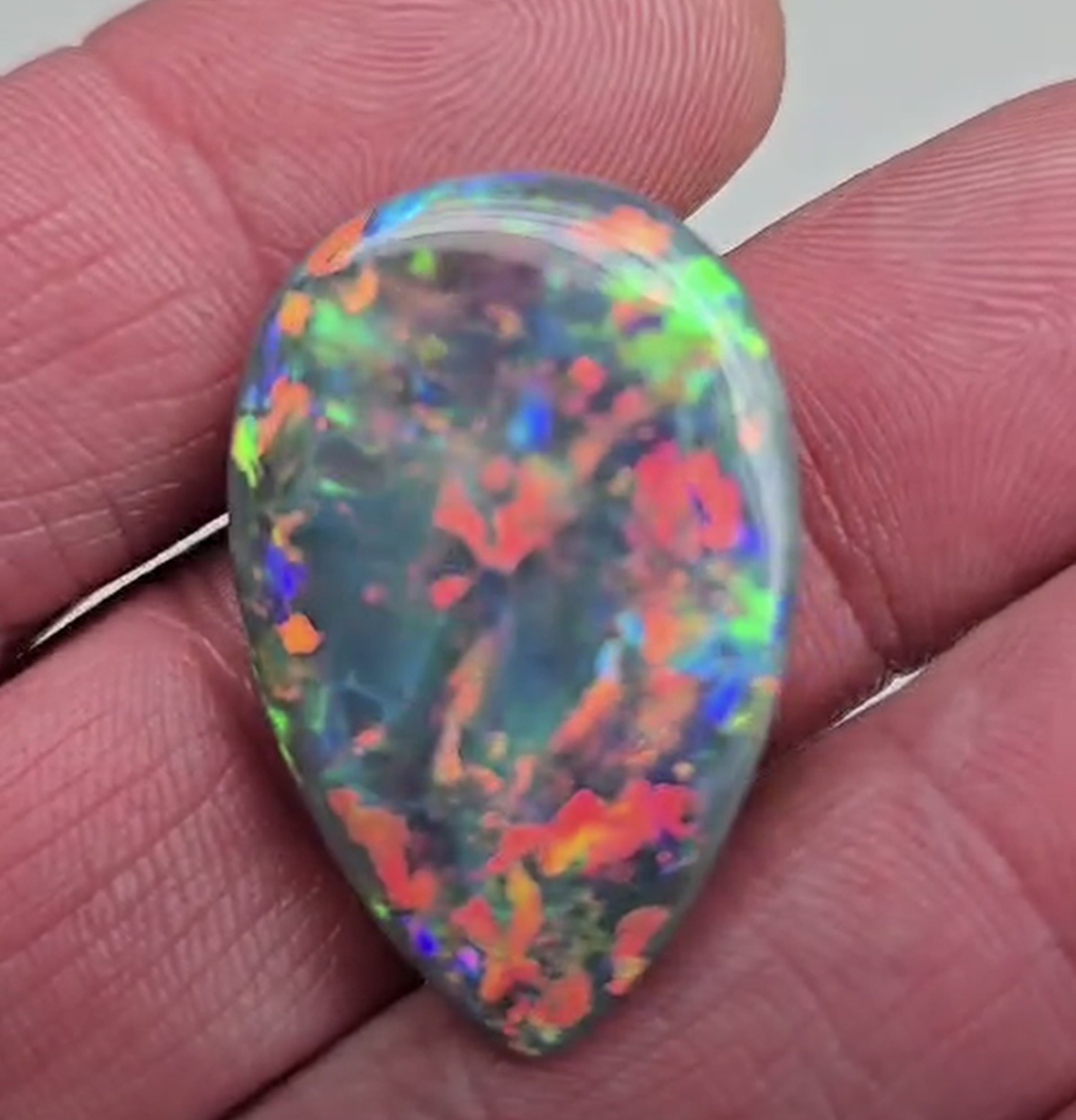
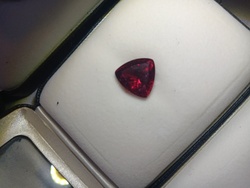
The item is a loose, polished teardrop-cut gemstone resting in the palm of a human hand to demonstrate scale. The stone displays a dark body tone, characteristic of black or dark boulder opals, featuring a vibrant play-of-color across its entire domed surface. The prominent flashes of color include striking neon reds, oranges, electric blues, and vivid greens, distributed in a mottled, broad-flash pattern against a dark matrix or potch background. The cabochon has a smooth, highly polished domed top and a tapered, pointed bottom end. There are no visible maker's marks, signatures, stamps, or specific brand identifiers present on the visible surface of the stone. The overall physical characteristics are consistent with natural precious opal, though specific geographic origin, geological treatment, exact carat weight, and material composition remain unverified without physical gemological testing and equipment inspection. The item exhibits a high polish and glossy finish typical of professionally cut and finished lapidary work.
AI Appraisal Report
Based on what I can see in the photograph, this loose, polished teardrop-cut gemstone displays characteristics consistent with a natural black or dark boulder opal, featuring a vibrant play-of-color with striking neon reds, oranges, electric blues, and vivid greens. However, I cannot verify from a photo alone the exact carat weight, internal structural integrity, specific geographic origin, or whether any treatments have been applied to enhance the stone. I must emphasize that my evaluation is based on the working assumption that this is a natural precious opal of similar optical quality. The estimated value range of $1,500 to $3,000 reflects typical market behavior for a finished cabochon of this apparent visual caliber, assuming the material is natural and untreated. General market demand for high-flash opals remains steady among collectors and custom jewelers, though prices vary significantly based on brilliance, pattern, and body tone. To establish a legally sound and fully supported valuation, I would need physical gemological testing and equipment inspection, including microscopic examination and specific gravity testing, to confirm the stone's natural origin and rule out synthetics, doublets, triplets, or polymer treatments. If the stone were to turn out to be a synthetic laboratory-created opal, a glass simuland, or a composite doublet/triplet rather than a solid natural stone, the market value would drop substantially, likely falling into the $100 to $300 range.