AI Appraisal Estimate

AI-generated estimates · not official valuations

From the user

What was submitted

Photo and notes provided by the user — not generated by AI

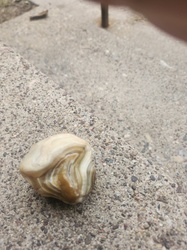
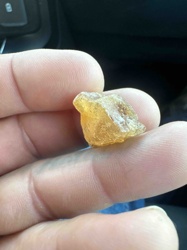
Submitted item photo
Submitted photo · May 27, 2026

User's notes

No additional notes provided.

AI analysis below

AI appraisal

AI analysis & estimate

AI-Generated · Verify before acting

Everything below is generated by AI for informational purposes only. AI can make mistakes — the AI may misidentify items or misattribute them (artist, maker, brand, designer, origin, era). This is not an official valuation and should not be used for insurance, sale, tax, estate, legal, or lending purposes — or any decision requiring a certified appraisal. It is not an authoritative claim about any person, brand, or rights holder — do not share or rely on it as a factual statement about a third party. Always consult qualified professionals before making financial decisions.

Read the full disclaimer

AI Identification

·Not independently authenticated·Verify before acting

Raw Honey Calcite Specimen

Minerals and Gemstones

AI Estimated Value

·Not an official valuation·Verify before acting

$12.00 - $18.00

As of May 27, 2026

AI Item Analysis

·AI can make mistakes·Verify before acting
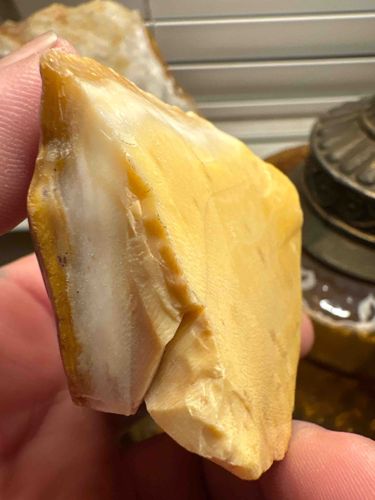
This specimen is a raw, unpolished piece of Honey Calcite, a calcium carbonate mineral known for its distinctive golden-yellow to amber coloration. The piece exhibits a waxy to vitreous luster, characteristic of the mineral's rhombohedral crystal structure. In terms of physical appearance, it features a semi-translucent body with stratified layers of creamy white and deep honey-orange, suggesting a sedimentary or hydrothermal formation process. The size appears to be approximately 2 to 3 inches in length, comfortably held between fingers. Notable features include the step-like cleavage planes and jagged, conchoidal fractures where the stone has been broken from a larger matrix. There are no visible maker's marks, as this is a natural geological object rather than a manufactured item. The condition is raw and natural, with visible surface abrasions and internal fractures that are inherent to the mineral's 3-rating on the Mohs hardness scale. The craftsmanship is entirely natural, displaying geological 'folding' or banding that indicates millions of years of mineral deposition. Its quality is determined by the clarity of its color and the lack of dulling impurities.
AI Appraisal Report

·AI can make mistakes·Verify before acting
Based on my visual examination of this raw Honey Calcite specimen, I have determined it to be a representative example of a common calcium carbonate mineral. The specimen displays the classic rhombohedral cleavage and 'honeyed' amber-to-cream banding characteristic of material sourced frequently from Mexico or Utah. The waxy luster and translucency suggest a natural origin, though authentication via image alone cannot rule out heat treatments or chemical baths sometimes used to enhance color or surface texture. In the current mineral and gemstone market, Honey Calcite is considered an 'abundant' mineral. It is primarily valued for its metaphysical associations and decorative appeal rather than rarity. Comparable specimens of this size (2-3 inches) and weight (est. 150-250g) typically retail in the low double-digit range at gem shows and specialty rock shops. The value is tempered by the mineral's low Mohs hardness (3), which has resulted in the visible surface abrasions and internal 'shatter' fractures noted in the description. Factors impacting the value include the pleasing saturation of the golden-orange bands and the lack of distracting matrix (host rock). However, as a common mineral, it lacks the investment potential of rare crystallized specimens. For a definitive authentication, I would require a physical refractive index (RI) test and an acid test to confirm carbonation. A physical inspection would also confirm if the 'waxy' texture is natural or a result of an acid-dipping process used to smooth the surface of raw calcite. Valuation assumes no significant provenance or historical importance.

Get your items appraised

Instant estimates of your treasures with AI-powered appraisals

Browse More Appraisals