AI Appraisal Estimate

AI-generated estimates · not official valuations

From the user

What was submitted

Photo and notes provided by the user — not generated by AI

Submitted item photo
Submitted photo · June 1, 2026

User's notes

Antique turquoise silver bracelet

AI analysis below

AI appraisal

AI analysis & estimate

AI-Generated · Verify before acting

Everything below is generated by AI for informational purposes only. AI can make mistakes — the AI may misidentify items or misattribute them (artist, maker, brand, designer, origin, era). This is not an official valuation and should not be used for insurance, sale, tax, estate, legal, or lending purposes — or any decision requiring a certified appraisal. It is not an authoritative claim about any person, brand, or rights holder — do not share or rely on it as a factual statement about a third party. Always consult qualified professionals before making financial decisions.

Note

This analysis also relies on unverified notes provided by the user, which may be incomplete or inaccurate and could affect the result.

Read the full disclaimer

AI Identification

·Not independently authenticated·Verify before acting

Vintage Native American Navajo Three-Stone Turquoise Silver Cuff Bracelet

Jewelry - Native American & Southwestern Art

AI Estimated Value

·Not an official valuation·Verify before acting

$850 - $1,200

As of June 1, 2026

AI Item Analysis

·AI can make mistakes·Verify before acting
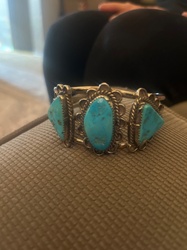
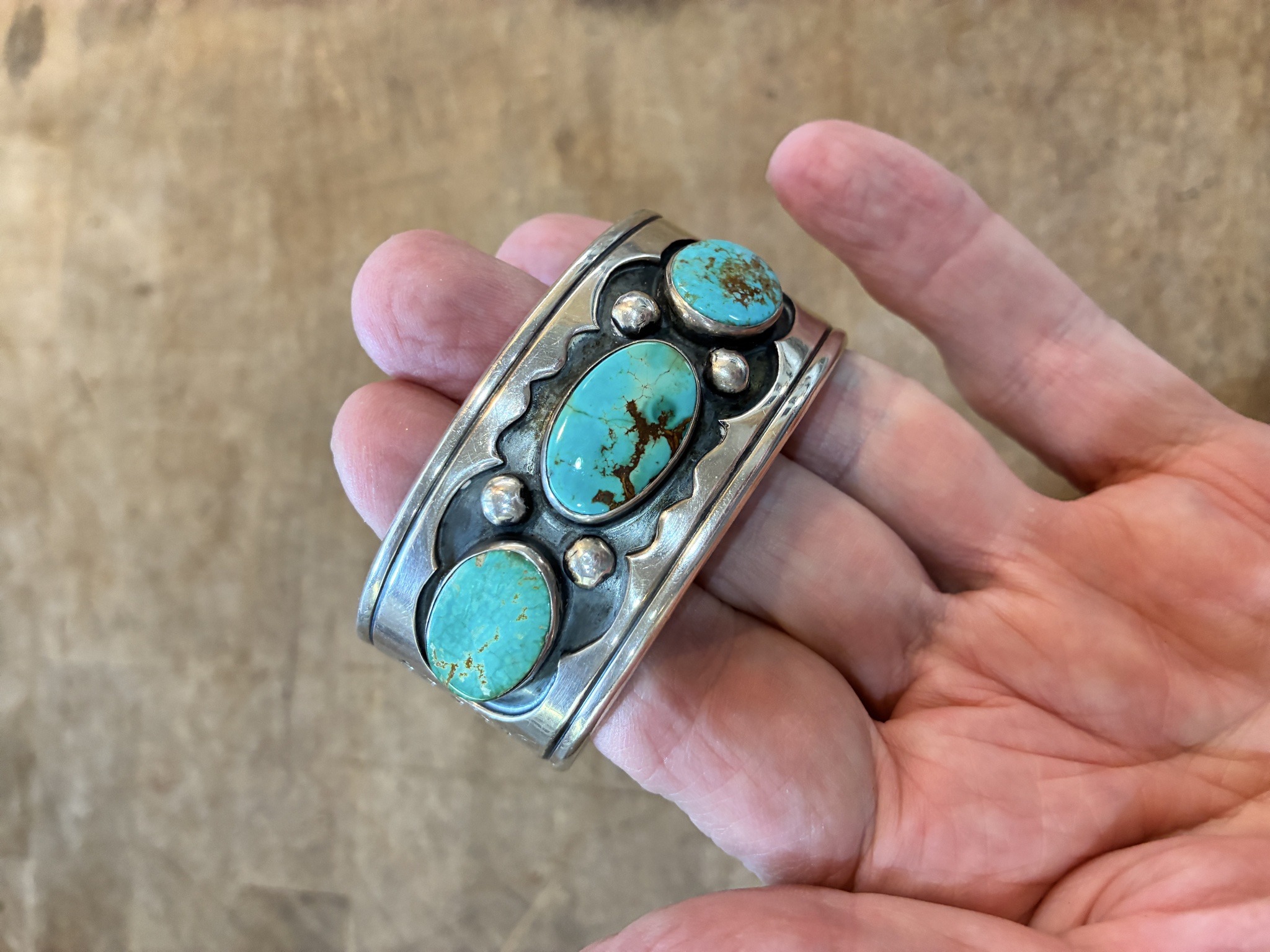
This is a significant sterling silver cuff bracelet featuring three prominent, hand-set oval turquoise cabochons. The stones exhibit a vibrant robins-egg blue to sea-green hue with a rich brown and golden iron pyrite matrix, characteristic of high-quality southwestern mines such as Royston or Morenci. Each stone is secured within a smooth bezel and surrounded by a decorative scalloped shadow-box frame. The design is further accented by traditional silver raindrops (bead work) placed symmetrically between the stones. The bracelet construction is heavy and substantial, utilizing a thick gauge of silver with rolled edges and parallel line stamping along the top and bottom borders. The central face of the cuff has been treated with an oxidized patina to create a 'shadow-box' effect, making the polished silver elements and stones pop. In terms of condition, the silver shows light surface scratches and a natural age-related patina consistent with mid-20th-century origins. The stones appear stable with no visible cracks, though the natural matrix surface shows characteristic texture. This piece reflects excellent Navajo craftsmanship, likely dating from the 1940s to 1970s, showcasing classic Fred Harvey era or post-war southwestern traditional aesthetics.
AI Appraisal Report

·AI can make mistakes·Verify before acting
Based on my visual examination of this Navajo-style three-stone turquoise cuff, I find the piece to be a high-quality example of mid-20th-century Native American silversmithing. The robust gauge of the silver and the hand-finished scalloped bezel work reflect a level of craftsmanship consistent with the post-war 'Second Phase' revival. The stones, likely sourced from the Royston or Morenci mines based on the golden-brown matrix and color saturation, are well-matched and exhibit the desirable 'high dome' cut. The use of shadow-box techniques and silver raindrops indicates a skilled creator, possibly from the 1950s or 60s. The market for authentic vintage Navajo jewelry remains strong, with collectors placing a premium on 'heavy' silver and natural, untreated stones. Comparables at auction for unsigned master-level cuffs of this weight and stone quality typically fall between $800 and $1,300. The absence of a hallmark is common for this era but does slightly limit the ceiling value compared to identified makers like Kenneth Begay or Julian Lovato. Critically, this appraisal is based on photographic evidence. A definitive valuation is limited by the inability to physically test the silver purity or confirm if the stones have been stabilized. In-person inspection is required to check for hidden fractures or signs of resin treatment. To fully authenticate this item and potentially increase its value, I recommend researching provenance (original receipts or family history) and performing a professional acid or X-ray fluorescence (XRF) test to confirm .925 sterling content.

Get your items appraised

Instant estimates of your treasures with AI-powered appraisals

Browse More Appraisals