AI estimate as of June 24, 2025 · verify with a professional before acting
AI-Generated · Verify before acting
Everything on this page is generated by AI for informational purposes only. AI can make mistakes — the AI may misidentify items or misattribute them (artist, maker, brand, designer, origin, era). This is not an official valuation and should not be used for insurance, sale, tax, estate, legal, or lending purposes — or any decision requiring a certified appraisal. It is not an authoritative claim about any person, brand, or rights holder — do not share or rely on it as a factual statement about a third party. Always consult qualified professionals before making financial decisions.
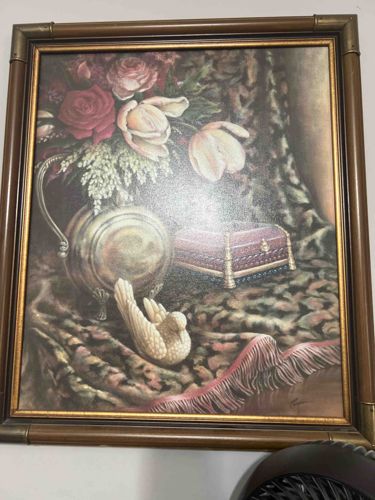
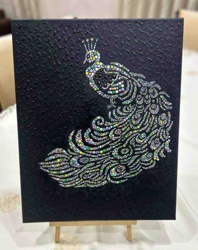
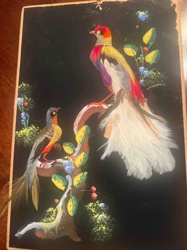
This item is a framed still-life painting or print, depicting a classical composition. The physical characteristics include a rectangular shape framed in what appears to be wood with a dark stain resembling bamboo or faux bamboo, featuring brass-toned corner accents and an inner gold-toned filet. The overall dimensions are typical for a medium-sized wall hanging. The materials visible are the canvas or print surface, pigments for the image, and a wooden frame with metallic accents. The color palette is rich and muted, dominated by deep reds, creams, and greens, with metallic silver and gold tones. Notable features within the painting include a bouquet of red roses and cream-colored tulips arranged in a silver-toned pitcher or urn. To the right of the pitcher, a deep red, rectangular box, possibly a jewelry casket, is depicted with intricate gold-toned detailing. In the foreground, a white, possibly ceramic or sculpted, bird figure (reminiscent of a dove or swan) rests on a patterned fabric, which appears to be part of a lavish still life setup. A red fringed textile or drape is also visible on the lower right of the composition. There are no visible condition issues such as tears, significant scratches, or major discoloration from the provided image. The surface has a slight sheen, suggesting either a varnished painting or a quality print. No clear manufacturing details, such as a prominent artist's signature or specific maker's marks, are discernible from this distance, although a faint signature might be present in the lower right corner. The style suggests a traditional or classical still life, potentially late 20th century, given the frame style, which sometimes points to mass-produced decorative art of that era. The execution appears competent, conveying depth and texture, indicative of decent craftsmanship for a decorative piece.
AI Appraisal Report
This framed still life, depicting flowers, a silver urn, a decorative box, and a bird, appears to be in very good condition with no visible tears, significant scratches, or major discoloration. Its authenticity as an original painting versus a print cannot be definitively determined from images alone. The slight sheen suggests either a varnished painting or a quality print with a surface coating. The frame style, often seen in late 20th-century decorative art, combined with the lack of a clearly discernible artist signature, suggests this is likely a mass-produced decorative print or a student work rather than a fine art painting by a recognized artist.Market comparables for similar decorative still life prints from the late 20th century typically fetch modest prices. Original paintings by lesser-known or unknown artists in this style also fall within a similar range unless there is a strong provenance. Demand for such decorative pieces is steady, particularly for interior design, but rarity is low as countless similar items were produced.Factors significantly impacting value include: lack of clear artistic attribution, possibility of it being a print rather than an original painting, and the generally common decorative nature. Were this determined to be an original painting by a recognized artist, or an exceptional quality print, its value would, of course, increase.For full authentication, an in-person examination is crucial to assess brushwork (or lack thereof), print quality, and material composition. High-resolution images of the surface and edges, as well as examination under UV light, could help distinguish between a painting and a print. Provenance documentation, if available, would be essential to verify its origin and artist. Scientific testing of pigments or paper/canvas might be needed for definitive dating and material analysis.