AI estimate as of November 17, 2025 · verify with a professional before acting
AI-Generated · Verify before acting
Everything on this page is generated by AI for informational purposes only. AI can make mistakes — the AI may misidentify items or misattribute them (artist, maker, brand, designer, origin, era). This is not an official valuation and should not be used for insurance, sale, tax, estate, legal, or lending purposes — or any decision requiring a certified appraisal. It is not an authoritative claim about any person, brand, or rights holder — do not share or rely on it as a factual statement about a third party. Always consult qualified professionals before making financial decisions.
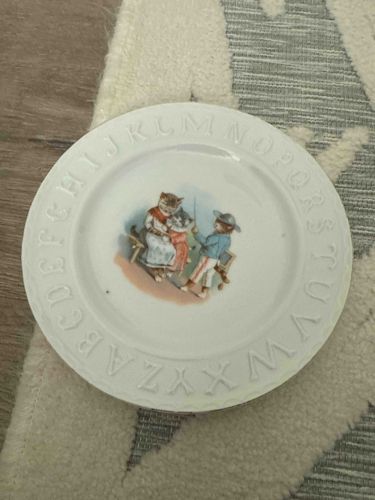
This item is an antique or vintage children's plate, crafted from white ceramic or porcelain. The plate features a slightly raised rim, which is embossed with the entire alphabet, 'A' through 'Z', presented in a decorative capital letter font. The central motif of the plate is a charming, hand-painted or transfer-printed illustration of three anthropomorphic cats. One larger cat, seemingly female, is seated and holding a smaller kitten, both rendered in warm tones of brown, tan, and white, with touches of red in their clothing. Adjacent to them, a third cat, appearing younger and male, is also seated and dressed in blue and white attire with a grey hat, perhaps holding a stick or a similar object. The illustration style suggests a 19th-century or early 20th-century aesthetic, common in children's literature and dinnerware of the period. The colors are somewhat muted, indicating age and possibly a transfer print process. The overall condition appears good with minor signs of wear consistent with its age, such as small specks or surface imperfections that could be residue or minor manufacturing flaws. No obvious chips, cracks, or significant repairs are visible from the provided image. The craftsmanship of the embossed alphabet indicates a good quality production for children's tableware, combining educational elements with playful imagery. The plate's design is typical of 'ABC plates' which were popular educational tools used during meal times for children.
AI Appraisal Report
Upon visual examination of the provided image, this antique or vintage children's ABC plate appears to be in good overall condition, consistent with its age and intended use. The white ceramic or porcelain body shows no immediately obvious chips, cracks, or significant repairs. The embossed alphabet from 'A' to 'Z' around the rim is clearly defined, suggesting a quality manufacturing process. The central illustration, featuring three anthropomorphic cats in what looks like a hand-painted or transfer-printed style, retains good detail and color, albeit muted, which is typical for pieces of this era. The aesthetic strongly aligns with late 19th to early 20th-century children's dinnerware. Small specks or surface imperfections are visible, which I assess as either minor manufacturing flaws or residue from age, not significant damage.
Market conditions for antique children's plates, particularly 'ABC plates' with appealing illustrations, show steady demand among collectors of early childhood memorabilia and antique ceramics. While these items are not exceedingly rare, good examples with charming, well-preserved illustrations like this one attract collectors. Comparable sales for similar embossed alphabet plates with engaging animal motifs typically fall within the $100-$300 range, depending on condition, specific maker (if identifiable), and illustration quality. The whimsical feline scene and educational alphabet significantly enhance its desirability.
My assessment of its authenticity and condition is based solely on the visual information available in the image. To fully authenticate this piece and provide a more precise valuation, an in-person examination would be crucial. I would need to inspect the front and back for maker's marks, glaze consistency, specific manufacturing techniques, and any professional repairs not visible in the image. Physical inspection would also allow for a tactile assessment of the surface and a clearer view of any subtle flaws or damage. Provenance documentation, though rarely available for such items, would also assist in confirming its age and origin. Scientific testing for material composition is generally not warranted for items in this price range but could confirm period-appropriate materials if authenticity were heavily contested.