AI estimate as of July 17, 2025 · verify with a professional before acting
AI-Generated · Verify before acting
Everything on this page is generated by AI for informational purposes only. AI can make mistakes — the AI may misidentify items or misattribute them (artist, maker, brand, designer, origin, era). This is not an official valuation and should not be used for insurance, sale, tax, estate, legal, or lending purposes — or any decision requiring a certified appraisal. It is not an authoritative claim about any person, brand, or rights holder — do not share or rely on it as a factual statement about a third party. Always consult qualified professionals before making financial decisions.
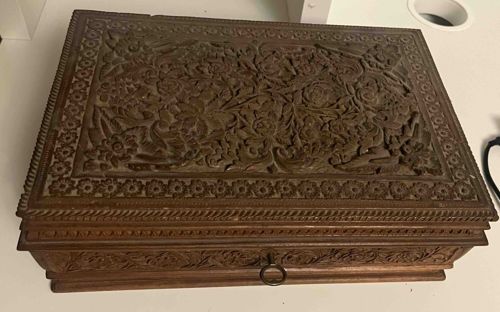
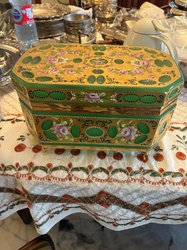
This is a rectangular wooden box, likely a jewelry or trinket box, characterized by intricate hand-carved details. The wood appears to be a medium to dark brown hue, possibly teak or another tropical hardwood, and exhibits a matte finish with a visible wood grain. The most prominent feature is the deeply carved top panel, which depicts a dense, organic pattern of flowers, leaves, and what appear to be birds or mythical creatures integrated into the foliage. The carving showcases significant depth and dimensionality, indicating skilled craftsmanship. The edges of the lid feature a bordered pattern, possibly a repeating floral or geometric motif, adding to its decorative appeal. The sides of the box also have carved borders, with the front side featuring an additional carved panel below the main lid. A small, simple metal ring pull is visible on the front, likely for a drawer or to help open the main compartment. There are no obvious signs of severe damage such as cracks or chips, though minor wear consistent with age and use, like slight darkening in recessed areas of the carving and a general patina, is present. The precision and complexity of the carving suggest a period when such handicraft was highly valued, potentially late 19th or early 20th century, possibly of Indian or Southeast Asian origin given the style of carving. The construction appears sturdy, and the detailed work points to a piece of good quality and a testament to manual artistry.
AI Appraisal Report
Upon examining the provided image, I assess this carved wooden jewelry/trinket box to be in very good condition for its presumed age. The intricate carving exhibits remarkable detail and depth without obvious signs of severe damage such as cracks or significant chipping. The matte finish and visible wood grain, along with the consistent dark patina within the recesses of the carving, suggest authentic aging and careful preservation. The visible metal ring pull appears consistent with period hardware, though its material would require in-person inspection.
Based on the highly detailed and deeply carved botanical and faunal motifs, often incorporating mythical elements, this piece strongly suggests an origin in late 19th to early 20th century India or Southeast Asia, where such exquisite handicraft was prevalent. Similar pieces, often identified as Anglo-Indian or originating from regions like Kashmir or Sri Lanka (Ceylon), command moderate to strong demand in the current market, particularly for examples with this level of carving quality. Comparables in online antique markets and auction results for intricately carved wooden boxes of this period and style typically range from $150 to $450, depending on size, wood type, and provenance. The quality of carving here places it at the higher end of this range.
Factors impacting value positively include the exceptional detail, apparent structural integrity, and desirable aesthetic. The primary limitation in full authentication from an image alone is the inability to physically inspect the wood for species identification (e.g., teak, rosewood), examine joinery for construction methods, or assess the interior for lining or additional compartments. Provenance documentation, such as original purchase records or family history, would significantly enhance value and authenticity verification. Scientific testing of the wood or patina would provide definitive dating and material identification, but this is usually reserved for higher-value items. Without physical inspection, I cannot definitively confirm its precise age or country of origin beyond a strong stylistic suggestion.