AI estimate as of October 10, 2025 · verify with a professional before acting
AI-Generated · Verify before acting
Everything on this page is generated by AI for informational purposes only. AI can make mistakes — the AI may misidentify items or misattribute them (artist, maker, brand, designer, origin, era). This is not an official valuation and should not be used for insurance, sale, tax, estate, legal, or lending purposes — or any decision requiring a certified appraisal. It is not an authoritative claim about any person, brand, or rights holder — do not share or rely on it as a factual statement about a third party. Always consult qualified professionals before making financial decisions.
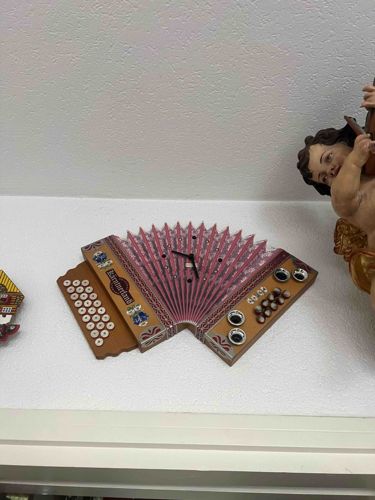
This item is a decorative wall clock designed in the shape of an accordion, specifically a 'Steirische Harmonika' style, commonly found in Alpine regions. The clock features a central 'bellows' section, rendered in pleated red and pink material or painted wood, which serves as the clock face. Small, possibly metallic, studs or dots mark the hours around the perimeter of the bellows, with black hour and minute hands centrally located. The 'keyboard' and 'bass' sides of the accordion are crafted from a light brown wood, possibly stained or lacquered, with decorative motifs. The left side, representing the bass button array, has numerous small, round, white buttons arranged in several rows on a recessed brown panel. The right side, corresponding to the treble keyboard, features a combination of larger circular elements, possibly simulating air buttons or registers, and a diagonal arrangement of smaller, oval-shaped buttons, again in a light brown color. Both wooden ends are adorned with painted stylistic elements, including blue crest-like designs and scrollwork in white and red, giving it a folk-art aesthetic. One of the blue crests on the left side appears to have text, possibly 'Kärntnerland', which is a region in Austria. The construction appears to be a mix of wood and fabric or painted material, likely mass-produced for tourist markets. The visible condition suggests good preservation with no immediate signs of damage, wear, or repairs, though details on its operational status as a clock are not visible. It appears to be a relatively modern decorative piece, likely from the late 20th or early 21st century, designed to evoke traditional musical instruments.
AI Appraisal Report
I have examined the image of this Accordion-Shaped Wall Clock, designed in the 'Steirische Harmonika' style. Visually, the condition appears good, with no obvious damage, significant wear, or visible repairs. The painting and structural integrity seem well-preserved. Authentication of materials like wood type or fabric composition is limited to visual cues; a physical examination would be needed to confirm these more definitively. The 'Kärntnerland' text on the blue crest suggests an Austrian regional origin.
This item falls into the category of decorative folk art or tourist souvenirs. Comparables in the market for similar novelty wall clocks, or Alpine-themed decorative items, typically range from modest prices. Factors impacting value include its decorative appeal, the niche market for Alpine folk art, and its functionality as a clock (which cannot be confirmed from images). Demand is likely limited to individuals seeking specific decorative styles or those particularly interested in Alpine culture or accordions. Rarity is low; these items were likely mass-produced. Its value is primarily decorative, not as a collectible antique, given its likely modern manufacturing (late 20th/early 21st century).
Limitations in authenticity verification are significant. Without physical inspection, I cannot verify operational status of the clock mechanism, precise materials used, or confirm manufacturing details beyond visual assessment. Provenance documentation could offer insight into its exact age and origin within tourist markets, but is unlikely to significantly alter its appraisal value. Scientific testing is not typically applied to items of this nature.