These notes were written by the person who submitted this item. Appraiser.AI has not verified them, and the AI's identification and estimate may rely on them.
AI Estimated Value
Not an official valuation
$80 - $150
AI estimate as of August 28, 2025 · verify with a professional before acting
AI-Generated · Verify before acting
Everything on this page is generated by AI for informational purposes only. AI can make mistakes — the AI may misidentify items or misattribute them (artist, maker, brand, designer, origin, era). This is not an official valuation and should not be used for insurance, sale, tax, estate, legal, or lending purposes — or any decision requiring a certified appraisal. It is not an authoritative claim about any person, brand, or rights holder — do not share or rely on it as a factual statement about a third party. Always consult qualified professionals before making financial decisions.
This analysis also relies on unverified notes provided by the user, which may be incomplete or inaccurate and could affect the result.
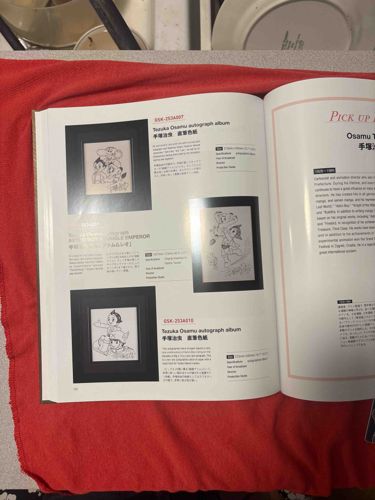
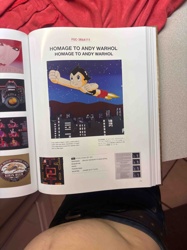
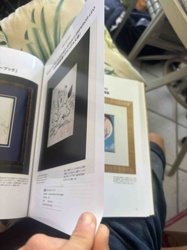
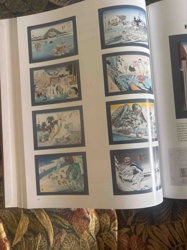
This item is an open catalog or art book, specifically a Japanese animation catalog, as indicated by the context provided. The book features several black and white illustrations, likely original production art or reproductions of autographs, arranged neatly within framed sections on the page. The pages are bright white with black text and some red accents, suggesting a modern and clean design. The presence of 'Tezuka Osamu autograph album' on the page clearly identifies the content. The illustrations depict well-known characters from Osamu Tezuka's works, such as Astro Boy/Mighty Atom (seen in the bottom left and top left frames) and what appears to be characters from Jungle Emperor Leo/Kimba the White Lion (top left, though the characters are styled in a way that suggests a classic Tezuka drawing style). Each image is presented with surrounding text, some of which lists details like 'Original print series', 'Material', 'Sheet size', 'Edition size', 'Signed by', 'Production year', and 'Condition'. Given the focus on production details and the presence of what appear to be limited edition print information, this book likely serves as a catalog for collectors or an informational art book detailing Tezuka's works and possibly autograph reproductions. The visible condition of the book pages suggests good preservation with no apparent tears, creases, or significant discoloration. Its construction appears to be standard for a softcover or perhaps a sturdy paperback art book, designed for reference or display. The craftsmanship is professional with clear printing and well-organized layouts.
AI Appraisal Report
Upon my virtual examination of this 'Tezuka Osamu Autograph Album Catalog,' I find it to be an exceptionally well-preserved example of a Japanese animation art book or catalog. The pages appear bright white with crisp black text and red accents, indicating excellent care and minimal, if any, signs of aging like discoloration or foxing. There are no visible tears, creases, or major imperfections. This suggests a condition rating of near fine to fine. Authenticity, regarding the catalog itself, appears solid; it presents as a professionally produced publication. However, it is crucial to understand that this is a catalog featuring illustrations and information about potential autographs or prints, not the original autographs themselves. The item is a Japanese animation catalog, which points to a specific audience and market. Given the visible information frames detailing 'Original print series,' 'Signed by,' and 'Edition size,' it likely serves as a reference for collectors of Tezuka's limited edition prints or autograph reproductions.
For market conditions, Tezuka Osamu's legacy ensures a constant, albeit niche, demand for his related merchandise. While this is not an original autograph or production cel, it is a high-quality catalog of such items. Comparables would include other official, well-preserved art catalogs or reference books on iconic animators. Rarity for such a catalog would depend on its print run; without that information, it's difficult to gauge precisely. However, its specific focus might limit its general availability outside Japan or specialized collector channels.
The primary factors impacting value are the excellent condition and its clear identification as a Tezuka Osamu compilation. The detailed information within each framed section adds significant value as a reference tool.
Limitations on authenticity verification are significant without a physical inspection. I cannot verify the legitimacy of the 'autographs' or 'prints' depicted within the catalog, only that the catalog itself appears to be an authentic publication. To fully authenticate the content or the book's specific edition, I would need to physically examine the paper stock, binding, printing methods (e.g., halftone patterns for reproductions), and any ISBN or publication details for cross-referencing with known Tezuka bibliographies. Provenance documentation, such as purchase records or confirmed history from a reputable source, would also greatly aid in authentication and value assessment. Scientific testing would not be applicable to authenticate the catalog itself, but could be for any original art or signatures it *describes*.