AI Appraisal Estimate

AI-generated estimates · not official valuations

From the user

What was submitted

Photo and notes provided by the user — not generated by AI

Submitted item photo
Submitted photo · June 10, 2026

User's notes

No additional notes provided.

AI analysis below

AI appraisal

AI analysis & estimate

AI-Generated · Verify before acting

Everything below is generated by AI for informational purposes only. AI can make mistakes — the AI may misidentify items or misattribute them (artist, maker, brand, designer, origin, era). This is not an official valuation and should not be used for insurance, sale, tax, estate, legal, or lending purposes — or any decision requiring a certified appraisal. It is not an authoritative claim about any person, brand, or rights holder — do not share or rely on it as a factual statement about a third party. Always consult qualified professionals before making financial decisions.

Read the full disclaimer

AI Identification

·Not independently authenticated·Verify before acting

Majolica Style Ceramic Pitcher

Ceramic Tableware and Decorative Arts

AI Estimated Value

·Not an official valuation·Verify before acting

$75 - $150

As of June 10, 2026

AI Item Analysis

·AI can make mistakes·Verify before acting
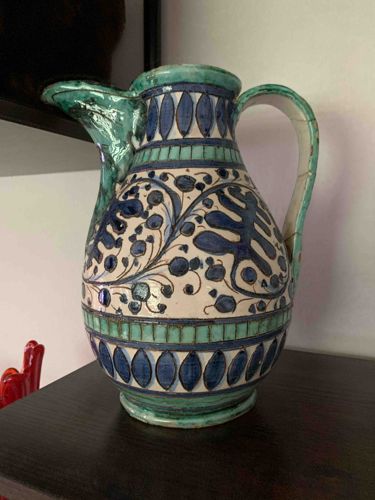
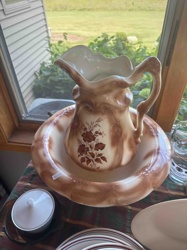
This is a ceramic pitcher, likely made of earthenware, adorned with vibrant and intricate hand-painted decorations in a style reminiscent of Majolica ware. The primary colors utilized are a rich cobalt blue and an earthy teal-green, set against an off-white or cream-colored ground. The pitcher features a bulbous body that tapers slightly towards the neck, leading to a flared rim with a prominent spout. A single, sturdy handle arches from the neck to the upper body, also painted in the teal-green. The decoration includes bands of geometric patterns; specifically, there's a band of repeating blue ovals or stylized leaves framed by teal-green on both the neck and the lower portion of the body, just above the foot. The central, dominant decorative element features organic, swirling motifs with numerous small dots and larger, amorphous shapes in blue, evoking floral or foliate designs. There are no visible chips or cracks. The surface exhibits a slight sheen, suggesting a glazed finish. The craftsmanship appears to be folk art or artisanal due to the hand-painted nature and slight irregularities in the glaze application, particularly visible on the handle and spout where the green glaze appears somewhat mottled or uneven, adding to its character. The piece has a rustic charm and presents in good overall condition with an appealing patina consistent with its likely age and material. No specific maker's marks or signatures are discernible from the image, but the style points towards a Mediterranean or Middle Eastern influence, possibly 20th century.
AI Appraisal Report

·AI can make mistakes·Verify before acting
I have examined the provided image of this Majolica-style ceramic pitcher. Visually, the piece presents in good original condition, consistent with its description; I observe no visible chips or cracks. The hand-painted decoration, featuring cobalt blue and teal-green on an off-white ground, is indicative of folk art or artisanal production, with slight irregularities in glaze application, particularly on the handle and spout, adding to its character rather than detracting significantly. This style often suggests Mediterranean or Middle Eastern origins, likely from the 20th century. Market conditions for decorative ceramic pitchers of this type, especially without a known maker or specific historical provenance, are generally modest. Comparable items appearing in online marketplaces and specialty antique shops typically fall within a decorative arts category rather than being considered fine art or significant historical artifacts. Demand is steady for appealing decorative ceramics, but rarity is not a significant factor here; similar hand-painted pitchers are not uncommon. Factors impacting value positively include its appealing aesthetics, good condition, and rustic charm. The lack of discernible maker's marks or specific provenance limits its collectibility among serious collectors, placing it more in the realm of attractive home decor. It is crucial to note the limitations of authenticity verification from images alone. While the style points to a specific genre, a full authentication would require physical examination to assess the exact glaze type, paste composition, and construction techniques. Microscopic analysis could confirm the age of the materials. Provenance documentation, such as purchase records or family history, would significantly enhance certainty regarding its origin and age. Without these, the appraisal remains based on visual aesthetic and general market trends.

Get your items appraised

Instant estimates of your treasures with AI-powered appraisals

Browse More Appraisals