AI estimate as of July 13, 2025 · verify with a professional before acting
AI-Generated · Verify before acting
Everything on this page is generated by AI for informational purposes only. AI can make mistakes — the AI may misidentify items or misattribute them (artist, maker, brand, designer, origin, era). This is not an official valuation and should not be used for insurance, sale, tax, estate, legal, or lending purposes — or any decision requiring a certified appraisal. It is not an authoritative claim about any person, brand, or rights holder — do not share or rely on it as a factual statement about a third party. Always consult qualified professionals before making financial decisions.
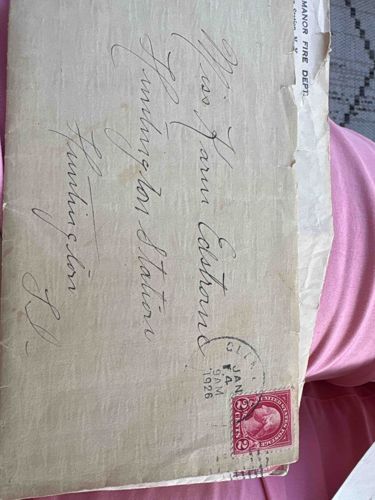
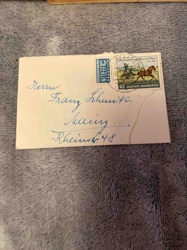
This item is an antique or vintage postal cover, specifically an envelope, dating from 1926. It is made of a light-colored, likely off-white or cream-colored, paper that shows significant aging and some discoloration, consistent with its almost century-old age. The overall dimensions appear to be standard for a letter envelope of its era, likely around 6 to 8 inches in length. Clear indications of its age include visible creasing, especially on the right side from what might be a fold, and general wear and tear around the edges. The most prominent feature is the handwritten address in elegant cursive script, addressing the envelope to "Miss Farm Eastbound, Huntington Station, Huntington, L.I." The ink appears to be black or dark brown, and the penmanship suggests a deliberate, careful hand. In the upper right corner, there is a red postage stamp with a portrait, likely of George Washington, and a '2 CENTS' denomination, indicating it was a two-cent stamp. Overlapping the stamp and the address is a circular postmark, partially visible, which clearly indicates "JAN 14 AM 1926" and ‘CLINTON, TX’ or similar, confirming the date of mailing. There is also a partial return address or mailing label adhered to the top right edge, which appears to say "MANOR FIRE DEPT", offering a potential insight into the sender. The paper exhibits a slightly textured or fibrous appearance upon close inspection, which is typical for paper from this period. The envelope appears to have been opened, given the slight separation along the upper edge. The craftsmanship is that of a mass-produced item, though the handwritten address adds a unique, personal touch. The condition is good for its age, showcasing historical patina rather than severe damage, making it a well-preserved piece of postal history.
AI Appraisal Report
Upon examining the provided images of this 1926 handwritten envelope, I find it to be a well-preserved piece of postal history. The visual assessment confirms its authenticity based on the style of the stamp, the clear 1926 postmark from 'CLINTON, TX', and the period-appropriate paper and handwriting. The paper exhibits expected discoloration, creasing, and wear consistent with its nearly century-old age, yet it remains intact with no major tears or extensive foxing, indicating good preservation for an item of this type. The legible handwritten address and the partial 'MANOR FIRE DEPT' return address add specific historical context. The 2-cent George Washington stamp is common for the era, but its integration with the clear postmark enhances its appeal as an 'on cover' item.
Market conditions for early 20th-century postal covers are generally stable, with demand driven by philatelists, postal history enthusiasts, and collectors interested in specific locations or historical periods. While individual stamps of this common denomination hold minimal value, a complete, clearly postmarked cover from a specific date and location like 'Clinton, TX' carries a premium. Rarity is moderate; while 1926 covers are not exceedingly rare, a well-preserved example with a distinct return sender like a fire department can attract specific interest. The legibility of the postmark and clear date are key value drivers. Factors that significantly impact value include the clear date, the specific Texas postmark, the overall good condition, and the legibility of both the address and the return address. Without physical inspection, I cannot confirm the integrity of the paper fibers, the exact printing method of the stamp, or detect any potential repairs or alterations that would not be visible in an image. Full authentication would benefit from in-person examination to verify paper type, ink composition, and to rule out any advanced forgery techniques not discernible photographically. Provenance documentation, such as collection history, would also add to its authentication and value.