These notes were written by the person who submitted this item. Appraiser.AI has not verified them, and the AI's identification and estimate may rely on them.
AI Estimated Value
Not an official valuation
$40-70
AI estimate as of December 11, 2025 · verify with a professional before acting
AI-Generated · Verify before acting
Everything on this page is generated by AI for informational purposes only. AI can make mistakes — the AI may misidentify items or misattribute them (artist, maker, brand, designer, origin, era). This is not an official valuation and should not be used for insurance, sale, tax, estate, legal, or lending purposes — or any decision requiring a certified appraisal. It is not an authoritative claim about any person, brand, or rights holder — do not share or rely on it as a factual statement about a third party. Always consult qualified professionals before making financial decisions.
This analysis also relies on unverified notes provided by the user, which may be incomplete or inaccurate and could affect the result.
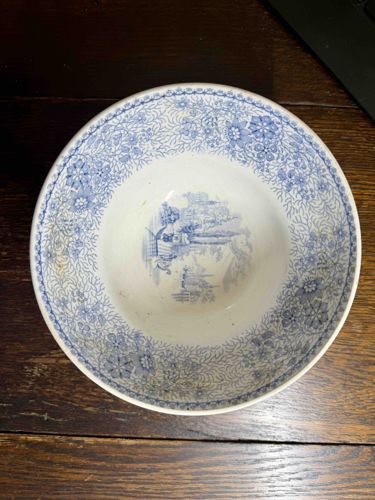
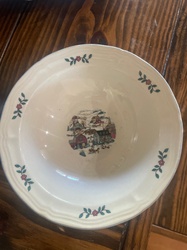
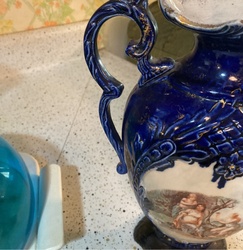
This is an antique or vintage ceramic soup plate or shallow bowl, measuring approximately 7 inches in diameter and 3.75 inches in depth according to the provided context. The item features a classic blue and white transferware decoration. The central motif depicts a pastoral or scenic landscape, likely an oriental-inspired 'Willow pattern' or a similar theme, showcasing buildings (possibly a pagoda or house), trees, and what appears to be water or a bridge. The imagery is finely detailed, rendered in a consistent medium-blue tone against a stark white ceramic base. Surrounding this central design, the rim of the bowl is adorned with a dense, intricate border pattern consisting of floral elements, possibly chrysanthemums or similar stylized flowers, interspersed with delicate scrolling foliage. This border pattern extends from the inner edge of the rim almost to the lip of the bowl. The color palette is characteristic of early to mid-19th to early 20th-century transferware, often made from earthenware or ironstone. Visible condition issues include a general patina consistent with age and use, some discoloration or staining, particularly in the central white area of the bowl, and potentially some crazing not clearly discernible from the image but often present in older ceramic pieces. There are no obvious chips, cracks, or repairs visible in the provided image. The craftsmanship appears to be of good quality, typical of mass-produced yet aesthetically pleasing household ceramics of its era.
AI Appraisal Report
I have examined the provided image and details for this blue and white transferware soup plate/shallow bowl. Its dimensions, 7 inches in diameter and 3.75 inches in depth, are typical for such an item. The classic blue and white transferware decoration, particularly the oriental-inspired landscape and intricate floral border, points to a common design popular from the early 19th to early 20th centuries. The consistent medium-blue tone and stark white base are characteristic of this period.
Based on the visual evidence, the condition appears good for its age, displaying a general patina, some discoloration or staining in the central white area, but no obvious chips, cracks, or repairs. While crazing is not clearly visible in the image, it is often present in older ceramic pieces and would be expected. The craftsmanship appears standard for mass-produced household ceramics of the era.
Market conditions for transferware like this are steady but not high unless it's a rare pattern, maker, or in pristine condition. Comparables for common patterns in good, but not perfect, condition typically range in the lower to mid-double digits. This piece appears to be a common pattern, likely earthenware or ironstone. Demand is consistent among collectors of blue and white ceramics, but rarity is not a significant factor here without specific maker's marks or pattern identification.
Factors impacting value include the commonality of the pattern, the visible staining, and the lack of a discernible maker's mark. If it were a rarer pattern, an identifiable prestigious maker (e.g., Spode, Wedgwood), or in mint condition, the value would be higher.
My primary limitation in authenticity verification from images alone is the inability to physically inspect the piece for maker's marks on the underside, assess the exact texture and weight, or confirm the absence of hairline cracks, repairs, or significant crazing. An in-person examination, potentially accompanied by provenance documentation (e.g., original receipts or family history), and scientific testing (e.g., thermoluminescence dating for extreme cases) would be needed for full authentication and in-depth condition assessment. However, for a common transferware item, such extensive measures are usually not economically justified.