AI estimate as of October 23, 2025 · verify with a professional before acting
AI-Generated · Verify before acting
Everything on this page is generated by AI for informational purposes only. AI can make mistakes — the AI may misidentify items or misattribute them (artist, maker, brand, designer, origin, era). This is not an official valuation and should not be used for insurance, sale, tax, estate, legal, or lending purposes — or any decision requiring a certified appraisal. It is not an authoritative claim about any person, brand, or rights holder — do not share or rely on it as a factual statement about a third party. Always consult qualified professionals before making financial decisions.
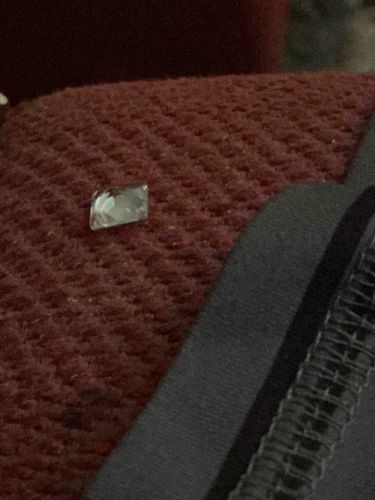
The item in question is a small, clear, faceted object, likely a gemstone or a piece of glass. Its shape appears to be a rectangular or possibly an emerald cut, displaying multiple flat surfaces or facets designed to reflect light. The material is transparent and colorless, with good clarity, allowing light to pass through with minimal obstruction. The size is relatively small, suggesting it could be an accent stone for jewelry, a decorative element, or a loose component. There are visible reflections and refractions within the object, indicating well-defined facets, although the precise number and arrangement are difficult to ascertain due to the image's resolution. No apparent inclusions or significant internal flaws are visible from this vantage point. The edges and corners appear relatively sharp, suggesting it is either recently cut or has not sustained significant wear. Given its clear and brilliant appearance, it resembles a diamond simulant, cubic zirconia, or perhaps a portion of a larger glass crystal that has broken off. There are no discernible maker's marks, signatures, or stamps. Based on the lack of unique identifying characteristics for a natural gemstone in this image, its estimated age is difficult to determine without further testing, but it could be a modern piece. Its primary quality indicator is its clarity and faceting. There are no visible condition issues such as chips, cracks, or significant abrasion, though a close inspection would be necessary to confirm. The item rests on what appears to be a textured, reddish-brown fabric, possibly upholstery, with a darker grey fabric element to its right, which helps contextualize its diminutive size.
AI Appraisal Report
I have visually examined this small, clear, faceted object from the provided image. Its transparency, colorless nature, and well-defined faceting suggest it is either a gemstone or decorative glass. The cut appears to be an emerald or rectangular variation, designed to optimize light reflection. Condition-wise, the piece appears excellent; I can discern no chips, cracks, or significant abrasions. The edges and corners are sharp, indicating either a recent cut or minimal wear.
Authenticity from an image alone is severely limited. While its brilliant appearance resembles a diamond simulant like cubic zirconia or strontium titanate, it could also be high-quality leaded glass. Without a physical examination, I cannot definitively determine its material composition, specific gravity, refractive index, or hardness, all crucial for authentication. There are no maker's marks or identifying features. Market conditions for such items vary significantly based on material. If it's a decorative glass piece, demand is low, and value is minimal. If it's a high-quality synthetic gemstone, value increases slightly but remains modest due to mass production.
Factors significantly impacting value are material identification (natural gemstone vs. synthetic vs. glass) and size/carat weight, which are difficult to gauge precisely from the image. Its small size, regardless of material, limits its intrinsic value unless it’s a rare natural gemstone. Given the lack of identifying characteristics for a natural stone, and considering it could be glass or a common synthetic, I assign a conservative value. Full authentication would require in-person examination, specific gravity testing, refractometer readings, and potentially Raman spectroscopy or other gemological tests to confirm material and rule out natural origin.