AI estimate as of August 9, 2025 · verify with a professional before acting
AI-Generated · Verify before acting
Everything on this page is generated by AI for informational purposes only. AI can make mistakes — the AI may misidentify items or misattribute them (artist, maker, brand, designer, origin, era). This is not an official valuation and should not be used for insurance, sale, tax, estate, legal, or lending purposes — or any decision requiring a certified appraisal. It is not an authoritative claim about any person, brand, or rights holder — do not share or rely on it as a factual statement about a third party. Always consult qualified professionals before making financial decisions.
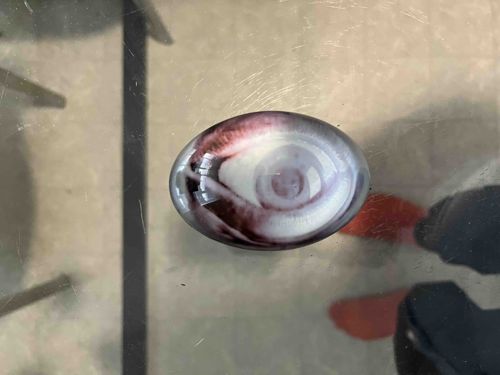
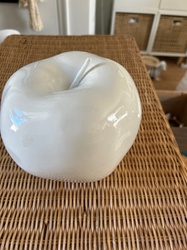
This item is an oval-shaped glass eye art piece, crafted to resemble a human or animal eye. Its dimensions appear to be approximately 2-3 inches in length. The primary material is glass, exhibiting a smooth, highly polished surface that reflects light, suggesting good optical clarity. The color palette largely consists of white/cream for the sclera-like outer portion, with a swirling pattern of deep reddish-brown or burgundy that simulates veins or irises. Within the central white area, there are concentric rings of purplish-gray, creating the illusion of a pupil and iris with depth. The construction is likely a lampwork or similar glass fusion technique, where different colors of molten glass are manipulated to form the desired pattern. There are no visible chips, cracks, or significant abrasions on the polished surface, indicating excellent condition or minimal handling. The reflective quality suggests it is either new, well-preserved, or recently cleaned. No discernible maker's marks or signatures are visible from this view. The style suggests a modern or contemporary decorative art piece, possibly designed as a paperweight, an inclusion in a sculpture, or a standalone curiosity. The craftsmanship appears to be of high quality, with precise color integration and a smooth, uniform shape, lacking any obvious bubbles or imperfections within the glass itself.
AI Appraisal Report
I have examined the image provided of this glass eye art piece. Based on its appearance, it is an oval-shaped glass eye, approximately 2-3 inches in length, crafted with remarkable clarity and a highly polished surface. The color scheme, featuring a white/cream sclera, deep reddish-brown veining, and a purplish-gray iris/pupil, indicates meticulous attention to detail. The lack of visible chips, cracks, or abrasions suggests excellent condition, possibly due to minimal handling or recent cleaning. This level of finish speaks to high-quality craftsmanship, likely employing lampwork or a similar glass fusion technique.
Authenticity, based solely on this image, seems to confirm it is a genuine glass art piece. However, without physical examination, I cannot definitively confirm the use of specific techniques or rule out very subtle internal flaws. For full authentication and to ascertain the artist or origin, an in-person examination would be crucial to look for hidden signatures, analyze glass composition, and detect any subtle manufacturing quirks. Provenance documentation, such as artist's records or purchase receipts, would significantly enhance authenticity and value verification.
In terms of market conditions, decorative glass art, particularly pieces with unique designs and high craftsmanship like this, generally see a steady demand. While not rare in the broadest sense, the specific design and quality of this piece could make it a desirable item for collectors of contemporary glass art or unique curiosities. Comparables would include contemporary studio glass art pieces of similar scale and complexity, which can range widely in value depending on the artist's reputation.
Factors impacting value include its excellent condition, the apparent skill in its creation, and its aesthetic appeal. The absence of a visible maker's mark limits its value, as identification of a renowned artist would significantly increase it. Without this, it's valued more as a decorative object than a documented artist's piece.
My appraisal is limited by the visual information available from a single image. A physical inspection would allow for a multi-angle examination, handling to assess weight and tactile qualities, and closer inspection for minute details or flaws not apparent in the photo. This would also enable specialized testing if needed to determine the exact type of glass or fabrication method.