AI estimate as of October 8, 2025 · verify with a professional before acting
AI-Generated · Verify before acting
Everything on this page is generated by AI for informational purposes only. AI can make mistakes — the AI may misidentify items or misattribute them (artist, maker, brand, designer, origin, era). This is not an official valuation and should not be used for insurance, sale, tax, estate, legal, or lending purposes — or any decision requiring a certified appraisal. It is not an authoritative claim about any person, brand, or rights holder — do not share or rely on it as a factual statement about a third party. Always consult qualified professionals before making financial decisions.
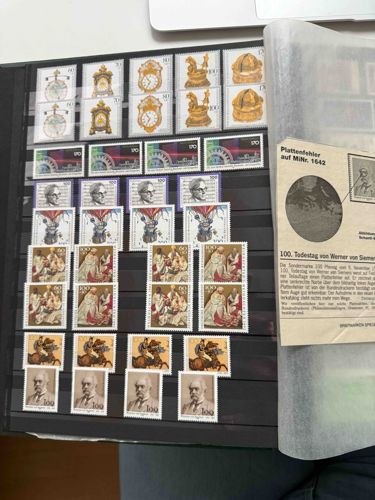
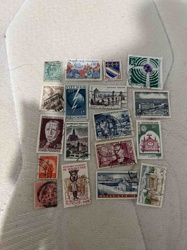
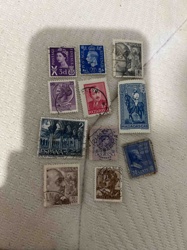
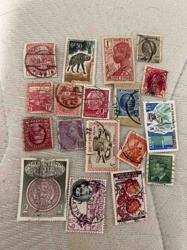
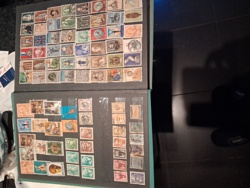
This item is a collection of German postage stamps presented within a black, bound stamp album. The album itself appears to be a standard philatelic album with clear protective strips or pockets, allowing visibility of the stamps while securing them. The stamps are arranged neatly in rows and columns. There are multiple series of stamps visible, indicating a curated collection rather than a random assortment.
Among the visible series, one features various historical clocks and timepieces, predominantly in gold and white hues with visible denominations of '70'. Another series displays scientific or industrial imagery, possibly related to technology or engineering, with '170' denominations in a gradient color scheme. A third distinct series showcases portraits of individuals, likely historical figures, with '100' denominations and a purple background. Yet another set depicts a more abstract or artistic motif, possibly representing mechanical components or fantastical creatures, also with '100' denominations. Further down, there are stamps illustrating religious or historical scenes, possibly depicting figures in traditional attire, with visible '60' denominations. Finally, a series portraying dynamic scenes with figures on horseback, carrying what appears to be a flag or banner, also bears '100' denominations. The lowest row visible contains stamps featuring portraits of an elderly gentleman with a beard, in sepia tones, also marked '100'.
All stamps appear to be in good condition, with clear perforations and minimal visible wear or creasing. Their placement within the album suggests they have been largely protected. The reverse side of the album or an inserted pamphlet details a "Plattenfehler auf MiNr. 1642" (plate error on Michel Number 1642) and references "100. Todestag von Werner von Siemens" (100th anniversary of the death of Werner von Siemens), indicating a focus on German philately and perhaps particular interest in error varieties or commemorative issues. This suggests a collection with a specific historical or thematic focus, potentially adding to its intrinsic value. The craftsmanship of the stamps themselves is typical for national postal services, involving offset printing on gummed paper with security features, though specific details like watermarks are not discernible from the image. The estimated age of these stamps likely ranges from the mid-to-late 20th century, given the subjects and printing styles common in West German philately. The presence of philatelic notes further underscores the collector's attention to detail and potential rarity of certain pieces.
AI Appraisal Report
Based on my visual examination of the provided image, this German Postage Stamp Collection in Album appears to be a well-maintained philatelic assortment. The stamps are neatly arranged within a standard album, suggesting careful handling and protection. The visible series, depicting themes such as historical clocks, industrial imagery, portraits of historical figures, religious scenes, and mounted figures, are consistent with West German issues from the mid-to-late 20th century, a period known for robust philatelic output. The condition of the stamps, exhibiting clear perforations and minimal visible wear or creasing, is good.
Key details, such as the mention of a "Plattenfehler auf MiNr. 1642" (plate error on Michel Number 1642) and the reference to "100. Todestag von Werner von Siemens," are significant. Such errors or commemorative issues, especially if authenticated, can significantly enhance value beyond face value. The collector's evident attention to detail, as indicated by these philatelic notes, points to a curated collection rather than a random accumulation.
Market conditions for mid-to-late 20th-century German stamps are generally stable, with specific errors or less common commemoratives commanding higher prices. Comparables would include similar thematic or country-specific collections in good condition. Demand often stems from specialized collectors focusing on German philately or specific thematic interests represented in the collection. The presence of a plate error suggests potential rarity for that specific stamp.
However, a definitive appraisal is limited by the visual nature of this examination. Authenticity verification for specific plate errors, watermarks, gum condition, and potential repairs cannot be confirmed from an image alone. An in-person examination would be crucial to verify the authenticity of the plate error, assess the true condition of all stamps (including revers’ side), and confirm watermarks, if any. Provenance documentation, though not present in the image, would also provide additional confidence in the collection's history. Without such physical inspection and detailed documentation, my assessment of rarity and intrinsic value is based on general philatelic knowledge and the visible cues.