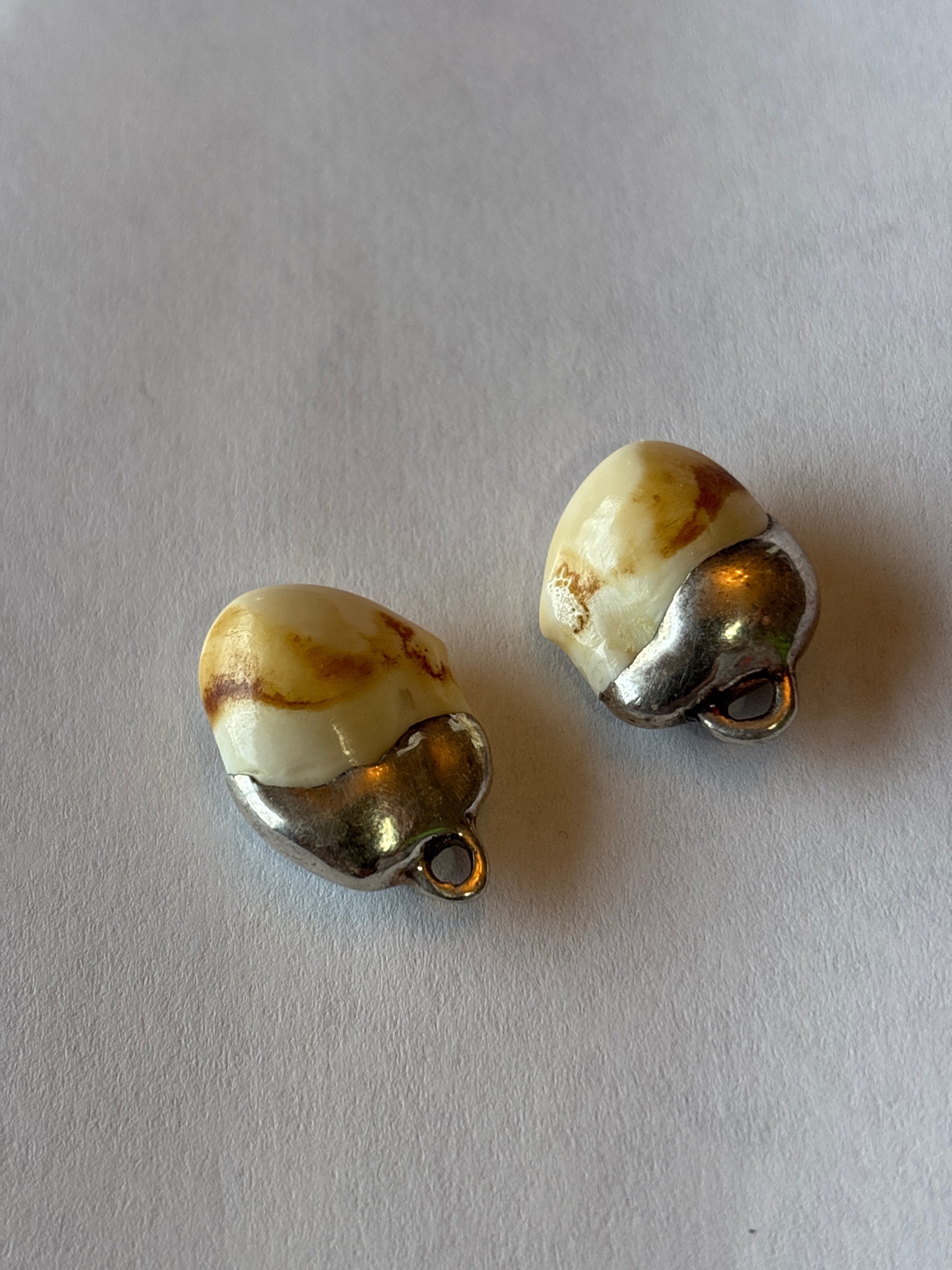
Pair of Silver-Mounted Grandel (Elk Ivory) Pendants
This is a pair of vintage jewelry components traditionally known as 'Grandeln' (grandels), which are the vestigial canine teeth of a red deer or elk. These specific items are mounted in silver caps, likely for use as charms or pendants on a traditional Alpine 'Trachten' necklace or watch chain. Each grandel exhibits a creamy white base color with the characteristic dark chocolate brown to butterscotch 'eye' or staining favored by collectors. The silver mounts are globular in shape with a polished finish and integrated suspension loops for attachment. The construction appears to be custom-fitted, typical of 19th or early 20th-century European craftsmanship, specifically from the Germanic or Austrian regions. Condition-wise, the silver shows minor surface abrasions and a slight warm patina consistent with age. One tooth shows a more pronounced textured texture near the gum line, indicating a natural growth pattern. Such items were historically popular as hunting trophies and are prized for the unique distribution of color on the enamel surface. There are no clear maker’s marks visible on the outer surfaces of the silver caps, which is common for artisanal hunting jewelry of this era.
AI-Generated Appraisal Disclaimer
Estimated Value
$250 - $400
Basic Information
Category
Antique / Vintage Jewelry and Hunting Memorabilia
Appraised On
April 27, 2026
Estimated Value
$250 - $400
Item Description
This is a pair of vintage jewelry components traditionally known as 'Grandeln' (grandels), which are the vestigial canine teeth of a red deer or elk. These specific items are mounted in silver caps, likely for use as charms or pendants on a traditional Alpine 'Trachten' necklace or watch chain. Each grandel exhibits a creamy white base color with the characteristic dark chocolate brown to butterscotch 'eye' or staining favored by collectors. The silver mounts are globular in shape with a polished finish and integrated suspension loops for attachment. The construction appears to be custom-fitted, typical of 19th or early 20th-century European craftsmanship, specifically from the Germanic or Austrian regions. Condition-wise, the silver shows minor surface abrasions and a slight warm patina consistent with age. One tooth shows a more pronounced textured texture near the gum line, indicating a natural growth pattern. Such items were historically popular as hunting trophies and are prized for the unique distribution of color on the enamel surface. There are no clear maker’s marks visible on the outer surfaces of the silver caps, which is common for artisanal hunting jewelry of this era.
Get Your Items Appraised
Instant estimates of your treasures with AI-powered instant appraisals