AI Appraisal Estimate

AI-generated estimates · not official valuations

From the user

What was submitted

Photo and notes provided by the user — not generated by AI

Submitted item photo
Submitted photo · May 27, 2026

User's notes

No additional notes provided.

AI analysis below

AI appraisal

AI analysis & estimate

AI-Generated · Verify before acting

Everything below is generated by AI for informational purposes only. AI can make mistakes — the AI may misidentify items or misattribute them (artist, maker, brand, designer, origin, era). This is not an official valuation and should not be used for insurance, sale, tax, estate, legal, or lending purposes — or any decision requiring a certified appraisal. It is not an authoritative claim about any person, brand, or rights holder — do not share or rely on it as a factual statement about a third party. Always consult qualified professionals before making financial decisions.

Read the full disclaimer

AI Identification

·Not independently authenticated·Verify before acting

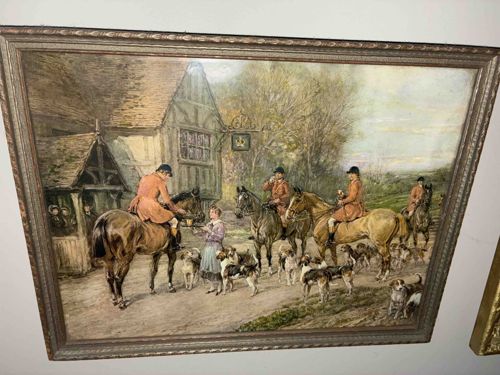
Vintage English Fox Hunting Print with Tavern Scene

Wall Art / Framed Prints

AI Estimated Value

·Not an official valuation·Verify before acting

$45 - $85

As of May 27, 2026

AI Item Analysis

·AI can make mistakes·Verify before acting
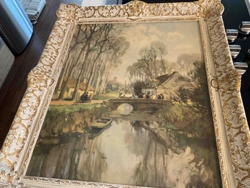
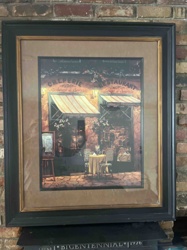
This item is a framed illustrative print depicting a traditional English fox hunting scene, likely a mid-20th-century reproduction of a 19th-century aesthetic. The artwork features four huntsmen in scarlet 'pinks' mounted on horses, congregating outside a timber-framed Tudor-style inn. A barmaid in a purple bodice and apron serves a stirrup cup to the foremost rider. The foreground is populated with a pack of foxhounds (beagles or harriers) in varying poses. The palette is dominated by earthy browns, greens, and muted skies, with high-contrast red in the riders' coats. The print appears to be on textured paper or cardstock that mimics canvas. It is housed in an ornate, silver-toned or metallic Gesso-over-wood frame with a repetitive rope or gadrooned leaf border pattern. Based on the style, this appears to be a mass-produced decorative piece from the 1940s-1960s. Visible condition issues include significant light foxing and yellowing in the upper central sky region, likely due to moisture or non-acid-free backing. The frame shows minor surface abrasions and dust accumulation in the crevices of the molding. There is no visible artist signature in the lower field, suggesting it may be a decorative lithograph produced by a company like the Goes Lithographing Co. or similar commercial publishers of the era. The composition follows the classical sporting art style popularized by artists like George Wright or Cecil Aldin.
AI Appraisal Report

·AI can make mistakes·Verify before acting
Based on my visual examination of this framed illustration, I have identified it as a mid-20th-century commercial lithographic reproduction of a traditional English sporting scene. The work mimics the 19th-century 'stoppage at the inn' motif popularized by artists such as Cecil Aldin. The print is executed on textured cardstock designed to simulate the look of a painting, a common technique for decorative home goods from the 1940s through the 1960s. The silver-toned Gesso frame, while ornate, shows signs of mass production typical of department store decor from that era. Condition is a significant factor in this valuation; the visible foxing and yellowing in the upper sky region indicate historical exposure to moisture or acid migration from the original wood backing, which diminishes its aesthetic and collector value. The market for mid-century sporting prints is currently saturated, with high supply and moderate demand limited primarily to 'shabby chic' or traditional interior design contexts rather than fine art collecting. Comparable sales for similar unsigned commercial lithographs in distressed frames consistently fall within the sub-$100 range. It is important to note that this appraisal is based on digital images alone. A physical inspection would be required to verify the printing method (e.g., offset lithography vs. earlier stone lithography) and to examine the verso for publisher marks. While this piece lacks the rarity of an original work or a signed limited edition, its value remains in its decorative appeal. For a definitive authentication, the print would need to be removed from the frame to inspect the paper's watermark and the degree of light-burn beneath the matting.

Get your items appraised

Instant estimates of your treasures with AI-powered appraisals

Browse More Appraisals