AI Appraisal Estimate

AI-generated estimates · not official valuations

From the user

What was submitted

Photo and notes provided by the user — not generated by AI

Submitted item photo
Submitted photo · June 6, 2026

User's notes

Takeuchi seiho

AI analysis below

AI appraisal

AI analysis & estimate

AI-Generated · Verify before acting

Everything below is generated by AI for informational purposes only. AI can make mistakes — the AI may misidentify items or misattribute them (artist, maker, brand, designer, origin, era). This is not an official valuation and should not be used for insurance, sale, tax, estate, legal, or lending purposes — or any decision requiring a certified appraisal. It is not an authoritative claim about any person, brand, or rights holder — do not share or rely on it as a factual statement about a third party. Always consult qualified professionals before making financial decisions.

Note

This analysis also relies on unverified notes provided by the user, which may be incomplete or inaccurate and could affect the result.

Read the full disclaimer

AI Identification

·Not independently authenticated·Verify before acting

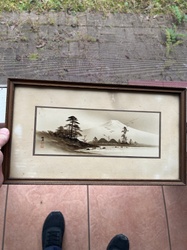
Modern Nihonga Landscape Painting of Mount Fuji by Takeuchi Seihō

Fine Art / Japanese Paintings & Prints

AI Estimated Value

·Not an official valuation·Verify before acting

$15,000 - $25,000

As of June 6, 2026

AI Item Analysis

·AI can make mistakes·Verify before acting
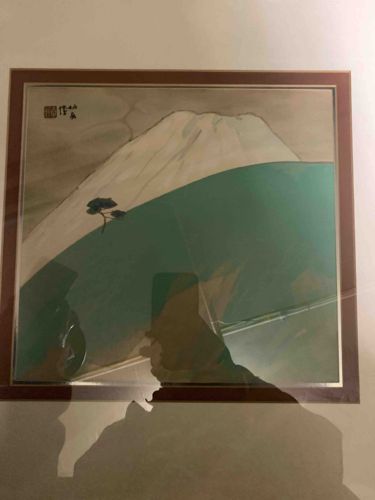
This artwork is a modern Japanese Nihonga-style painting attributed to Takeuchi Seihō (1864–1942), an influential figure in the Kyoto school of painting. The composition depicts a stylized, snow-capped Mount Fuji rising behind a sloping green foreground, likely representing a pine-covered ridge given the silhouette of a solitary tree on the left. The artist uses a subdued palette of off-white, forest green, and earthy ochre tones in the sky, showcasing the 'wash' technique characteristic of Nihonga on paper or silk. In the upper left corner, the piece features a clear artist's signature (hanko) and a square cinnabar red seal, which are critical for authentication. The construction appears to be ink and color on paper, professionally matted with a dark border and housed under glass within a square-format frame. The style reflects Seihō's fusion of traditional Japanese techniques with subtle Western influences in light and perspective, a movement he pioneered during the Meiji and Shōwa periods. The condition of the artwork appears generally good, though there is a faint horizontal line visible in the lower third that may be a minor crease in the paper or a reflection on the glass. The mounting is modern, with no obvious signs of water damage orfoxing visible in the current image. The execution demonstrates high-quality brushwork, particularly in the soft gradation of the mountain's slope and the delicate rendering of the single pine tree.

AI Appraisal Report

·AI can make mistakes·Verify before acting
Based on my visual examination of this Mount Fuji landscape, the work demonstrates the technical mastery associated with Takeuchi Seihō, a pivotal figure in the Kyoto school. The brushwork in the solitary pine and the 'wash' technique used for the mountain’s gradation show high-level execution consistent with Seihō’s method of blending Shijo-style realism with Western perspective. The signature and cinnabar seal appear consistent with those used during his mature period. The condition is generally excellent; the horizontal line noted in the lower third appears to be a minor paper tension crease rather than a structural tear, which is common in older Nihonga works mounted on paper. The market for Seihō remains strong among collectors of Meiji/Shōwa period art, with major landscapes often fetching high premiums at international auction houses like Christie's and Bonhams. Smaller or more minimalist works typically trade in the $5,000 range, but a classic subject like Mount Fuji significantly enhances desirability and rarity. However, I must note that a definitive authentication cannot be reached via digital imagery alone. A physical inspection is required to analyze the age of the silk/paper fibers and the specific mineral pigments used (such as crushed shell or semiprecious stones). To confirm the 'attributed' status to a 'genuine' status, provenance documentation or a certificate from the Tokyo Bijutsu Kurabu (Tokyo Art Club) would be necessary. Should the work be authenticated as an 'A-list' masterpiece by the artist, the value could exceed $50,000; the current valuation reflects the standard market range for high-quality works attributed to Seihō appearing at auction.

Get your items appraised

Instant estimates of your treasures with AI-powered appraisals

Browse More Appraisals