AI estimate as of October 25, 2025 · verify with a professional before acting
AI-Generated · Verify before acting
Everything on this page is generated by AI for informational purposes only. AI can make mistakes — the AI may misidentify items or misattribute them (artist, maker, brand, designer, origin, era). This is not an official valuation and should not be used for insurance, sale, tax, estate, legal, or lending purposes — or any decision requiring a certified appraisal. It is not an authoritative claim about any person, brand, or rights holder — do not share or rely on it as a factual statement about a third party. Always consult qualified professionals before making financial decisions.
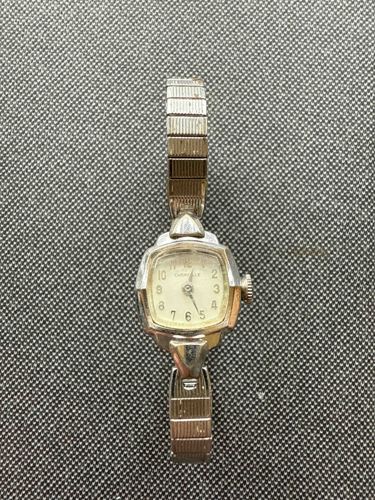
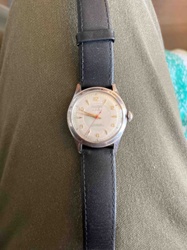
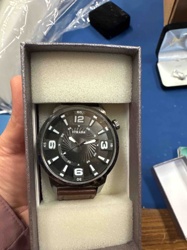
This is a vintage ladies' wristwatch from the brand 'Caravelle', featuring a small, cushion-shaped silver-tone case and an integrated expandable bracelet. The watch face is a light, possibly cream or ivory, color with black Arabic numerals for the hours (visible 1, 2, 3, 4, 5, 6, 7, 8, 9, 10) and minute markers. The hands appear to be a dark metallic finish, possibly black or blued steel, with a slender hour hand and a slightly broader minute hand, and no visible second hand. The brand name 'Caravelle' is printed below the 12 o'clock position. The crown, positioned at the 3 o'clock mark, is small and knurled, exhibiting a metallic luster consistent with the case. The watch case itself shows some signs of wear typical of an older piece, including minor surface scratching and possibly some loss of plating or tarnishing on the edges and corners, suggesting it is likely made of a base metal with a silver-tone finish. The integrated bracelet is a metal expansion band, common for watches of the mid-20th century, with a series of interlocking, rectangular segments that stretch. The segments of the bracelet also show minor surface wear and some discoloration consistent with age and use. The overall aesthetic points to a style popular in the mid-century, possibly dating from the 1950s to 1970s. The compact size and delicate design indicate it was intended for a woman's wrist. The craftsmanship appears to be standard for an everyday watch from that era, with no immediately discernible high-end complications or embellishments.
AI Appraisal Report
I have virtually examined this vintage ladies' Caravelle wristwatch and offer this appraisal. Based on the provided image, the watch features a cushion-shaped silver-tone case and an integrated expandable bracelet, both exhibiting typical signs of wear for a piece of its estimated age (1950s-1970s). The light-colored dial with black Arabic numerals and 'Caravelle' branding is legible. Condition is fair, showing minor surface scratches, tarnishing, and potential plating loss, particularly on the case edges and bracelet, which is consistent with regular use over decades. The expansion bracelet, while common for the era, also shows wear.
In terms of market conditions, vintage ladies' watches from everyday brands like Caravelle (a sub-brand of Bulova) generally do not command high prices unless they are in exceptional, unworn condition or possess unique design elements or precious metals. This piece, while charmingly vintage, appears to be a standard production model. Comparable sales for similar Caravelle ladies' watches in this condition range from $30 to $150, with those in better condition or with original boxes/papers fetching slightly more. Demand for such pieces is modest, appealing primarily to collectors of vintage accessories or those seeking a nostalgic item.
Factors impacting value are primarily the cosmetic condition and the brand's mass-market positioning. The lack of precious metals or high horological complications limits its intrinsic value. Authenticity, based solely on the image, seems likely for the 'Caravelle' brand as it aligns with known vintage styles. However, without an in-person examination, I cannot verify the functionality of the movement, the integrity of the crystal, or confirm that no repairs or part replacements have occurred. A physical inspection would be necessary to assess the movement's condition, identify any internal corrosion, and determine if it is in working order, all of which significantly influence value. Provenance documentation or scientific material testing are typically not sought for this category of watch due to cost outweighing potential value increase.