AI estimate as of August 16, 2025 · verify with a professional before acting
AI-Generated · Verify before acting
Everything on this page is generated by AI for informational purposes only. AI can make mistakes — the AI may misidentify items or misattribute them (artist, maker, brand, designer, origin, era). This is not an official valuation and should not be used for insurance, sale, tax, estate, legal, or lending purposes — or any decision requiring a certified appraisal. It is not an authoritative claim about any person, brand, or rights holder — do not share or rely on it as a factual statement about a third party. Always consult qualified professionals before making financial decisions.
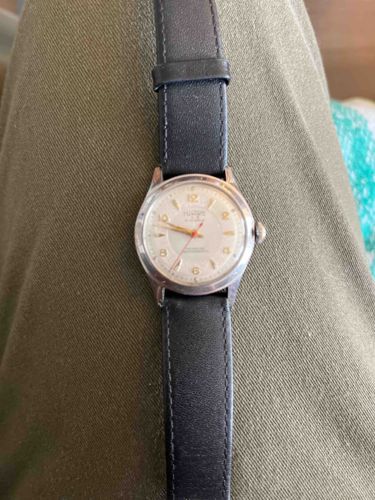
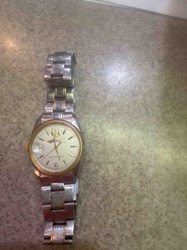
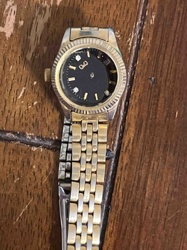
This is a vintage Fiurom automatic wristwatch, likely dating from the mid-20th century, possibly the 1950s or 1960s, given its aesthetic and 'automatic' inscription. The watch features a round, metallic case, appearing to be stainless steel or a similar alloy, consistent with everyday watches of the era. The dial is a light, possibly cream or silver, color with Arabic numeral hour markers at the 12, 2, 4, 6, 8, and 10 positions, while the remaining hour markers are indicated by applied metallic batons. The presence of both numerals and batons provides a classic vintage look. The hands are sword-shaped for hours and minutes, with a slender, red-tipped central seconds hand, which adds a subtle pop of color and functionality. The watch proudly displays 'FIUROM' below the 12 o'clock position and 'AUTOMATIC' just below the center, suggesting it is a self-winding mechanical movement. There are additional lines of text near the 6 o'clock position, though unreadable from the provided image, often indicating jewel count or other technical specifications. The crystal shows some signs of wear, including minor scratches, consistent with age and use. The case itself exhibits a light patina and some surface scratches, particularly noticeable around the bezel and lugs, indicative of regular wear but no major damage. The crown on the right side of the case appears to be original and proportionate to the watch. It is attached to a black, perhaps leather, strap that shows some creasing and wear, particularly where it would buckle, but is generally in fair condition. The overall craftsmanship appears solid for a mass-produced automatic watch of its time, designed for reliability and everyday wear. Its condition suggests it has been worn and enjoyed, but well-cared for, maintaining much of its original character.
AI Appraisal Report
Based on my visual examination of the Vintage Fiurom Automatic Wristwatch, I estimate its value to be in the range of $80 - $150.
The watch appears authentic for a mid-20th century Fiurom, consistent with the design cues of the 1950s-1960s. The 'AUTOMATIC' inscription and dial layout are typical for watches of this era. The condition is fair; while it shows expected signs of wear for its age, such as light patina, surface scratches on the case and bezel, and minor crystal scratches, there's no visible major damage. The strap, although showing creasing, appears functional, and the crown seems original.
Fiurom was a lesser-known brand compared to giants like Omega or Rolex. Their automatic movements were generally reliable but not highly sought after by collectors, placing them in the entry-level vintage watch market. This impacts demand significantly. The demand for such watches is modest, primarily attracting enthusiasts looking for an affordable, wearable vintage piece rather than a significant investment. Rarity is not a major factor here; similar mass-produced automatics from numerous smaller brands are relatively common.
Key factors impacting value are the unknown service history and functional status (e.g., accuracy, power reserve), which cannot be determined from images. The unreadable text near 6 o'clock could provide more technical insight (e.g., jewel count), but is unlikely to dramatically alter the valuation. Without physical inspection, I cannot verify the movement's condition, originality of all parts (beyond what is visible), or whether it is running. Full authentication and a more precise valuation would require an in-person examination by a watchmaker to assess the internal movement, confirm all parts' originality, and test its functionality. Provenance documentation, though rare for watches of this type, would also provide additional certainty.