AI estimate as of August 3, 2025 · verify with a professional before acting
AI-Generated · Verify before acting
Everything on this page is generated by AI for informational purposes only. AI can make mistakes — the AI may misidentify items or misattribute them (artist, maker, brand, designer, origin, era). This is not an official valuation and should not be used for insurance, sale, tax, estate, legal, or lending purposes — or any decision requiring a certified appraisal. It is not an authoritative claim about any person, brand, or rights holder — do not share or rely on it as a factual statement about a third party. Always consult qualified professionals before making financial decisions.
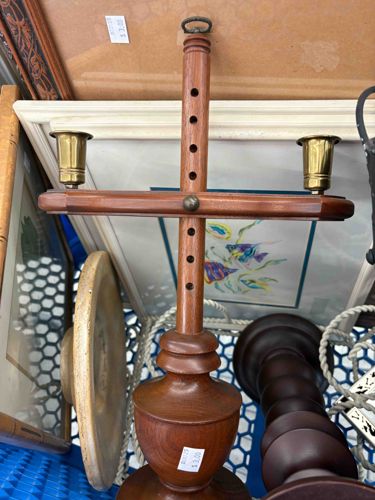
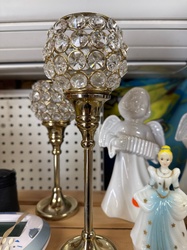
This item is a wooden candelabra designed to hold two candles. It is constructed primarily of what appears to be a medium-toned hardwood, possibly a fruitwood or mahogany, given its reddish-brown hue and visible grain. The central shaft is turned wood, featuring a series of concentric rings at its base that transition into a more bulbous, vase-like form, and then tapers upwards into a slender column. This column has a series of evenly spaced, small drilled holes running down its length, which are purely decorative and do not appear to serve a functional purpose for the candelabra itself. At the very top of the central shaft, there is a small brass or dark metal loop, suggesting it might have been designed to be hung or carried, perhaps in a nautical or rustic setting. Approximately two-thirds of the way up the central shaft, a horizontal arm extends outwards, secured by a single metal rivet or bolt, which has a dull, aged brass or bronze finish. This arm holds two brass candle holders, one at each end. These candle holders are simple, trumpet-shaped cups designed to accommodate taper candles. The wood shows a consistent, semi-glossy finish, indicating it has been polished or varnished.
Visible condition issues include a typical aged patina on both the wood and brass components. The brass candle holders show some oxidation and minor tarnishing consistent with age and use. The wood exhibits no overt signs of significant damage such as cracks, chips, or deep scratches. The turning of the wood appears well-executed, indicating a reasonable level of craftsmanship. While no specific maker's marks or signatures are visible in the provided image, a price tag of '$3.00' is affixed to the base, suggesting it was acquired from a resale or thrift environment. The overall aesthetic suggests a mid-20th century, possibly Colonial Revival or rustic folk art style. The item's design, particularly the central shaft's form and the brass accents, points to a functional yet decorative piece for ambient lighting.
AI Appraisal Report
Upon visual examination of the provided image, this two-arm wooden candelabra appears to be a well-preserved piece, likely dating from the mid-20th century, possibly reflecting a Colonial Revival or rustic folk art aesthetic. The medium-toned hardwood, exhibiting a reddish-brown hue, suggests fruitwood or mahogany, consistent with the period and style. The turned central shaft and brass candle holders are in good overall condition, showing a typical aged patina and minor tarnishing on the brass, consistent with age and use. Crucially, there are no overt signs of significant damage such as cracks, chips, or deep scratches on the wood. The presence of a '$3.00' price tag on the base indicates a past resale acquisition, which does not impact the intrinsic value but provides a historical context of its purchase.
From a market perspective, this type of decorative household item generally sees steady, but not high, demand. Comparable items, often found in antique shops, estate sales, or online marketplaces, typically command prices in the range of $30 to $75 for similar quality and condition. The 'decorative' drilled holes and the top loop are interesting design elements but do not significantly elevate market value. While the craftsmanship appears good, it doesn't indicate a renowned maker, which would significantly increase value. The item's primary value lies in its functional aesthetic and appeal as a vintage decorative accent.
Limitations in authenticity verification are inherent with image-based appraisals. A definitive determination of wood species would require in-person examination, possibly microscopic analysis. Furthermore, without physical inspection, it is impossible to assess the internal integrity of joins or the true material composition of the metal rivet. Provenance documentation, beyond the price tag, would be beneficial but is unlikely for such an item. Scientific testing is not typically warranted for an item of this value.