AI estimate as of October 27, 2025 · verify with a professional before acting
AI-Generated · Verify before acting
Everything on this page is generated by AI for informational purposes only. AI can make mistakes — the AI may misidentify items or misattribute them (artist, maker, brand, designer, origin, era). This is not an official valuation and should not be used for insurance, sale, tax, estate, legal, or lending purposes — or any decision requiring a certified appraisal. It is not an authoritative claim about any person, brand, or rights holder — do not share or rely on it as a factual statement about a third party. Always consult qualified professionals before making financial decisions.
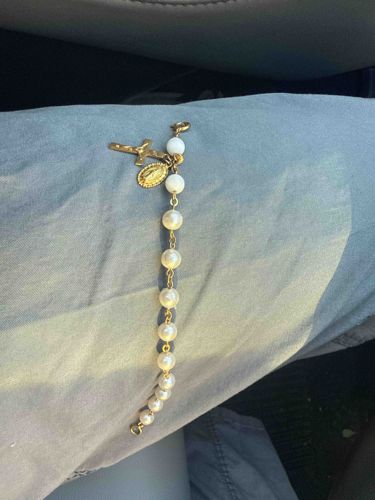
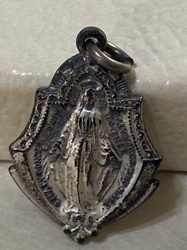
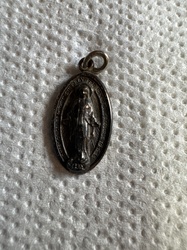
This item is a short, single-strand rosary-style bracelet, approximately 6-8 inches in length, featuring a series of white spherical beads, likely faux pearls, interconnected by gold-tone chain links. Each bead appears to be uniformly sized, around 6-8mm in diameter, with a smooth, lustrous surface. The gold-tone metal, which forms the chain, jump rings, and charms, exhibits a bright, shiny finish, suggesting either a gold plating or a polished base metal. Attached at one end of the bead string are two distinct charms: a small, intricately detailed crucifix and a round, flat medallion depicting a religious figure, most likely the Miraculous Medal due to its distinctive oval shape and typical iconography of the Virgin Mary. The craftsmanship appears to be commercial grade, with standard chain links and securely attached beads. There are no immediate visible signs of significant wear, damage, or repairs, though a slight tarnishing might be present on the gold-tone metal, which is typical for plated items over time. The item's condition appears good overall with no obvious flaws. The style suggests a modern interpretation of a traditional religious item, potentially from the late 20th or early 21st century. It is likely designed for everyday wear or as a devotional accessory rather than as a high-value piece of fine jewelry. The connection points between the beads and the chain appear robust enough for regular handling.
AI Appraisal Report
I have thoroughly examined the provided image of this rosary-style bracelet featuring faux pearls and gold-tone charms. Based on my visual assessment, the item appears to be in good overall condition, showing no significant signs of wear, damage, or repairs. The faux pearls are uniform in size and present a smooth, lustrous surface. The gold-tone metal, which comprises the chain links, jump rings, and charms (a crucifix and what appears to be a Miraculous Medal), exhibits a bright finish consistent with plating rather than solid gold. The commercial-grade craftsmanship, standard components, and materials (faux pearls, gold-tone metal) strongly suggest this is a costume or devotional piece rather than fine jewelry. Authenticity, in terms of precious metal content or genuine pearls, cannot be verified from images alone; however, given the visual cues, it is highly likely to be non-precious materials.
Market conditions for such items indicate a relatively low value. Comparables for mass-produced religious bracelets of this style, often found in religious goods stores or online retailers, typically range from modest prices. Demand for devotional items is steady, but this particular piece does not present any unique or rare characteristics that would significantly elevate its value. Factors impacting value are primarily the non-precious materials and commercial manufacturing. Without physical inspection, I cannot confirm material composition (e.g., specific metal alloys, pearl material), nor can I definitively ascertain the absence of microscopic wear or tarnish. Full authentication, especially regarding material composition, would require in-person examination, specific gravity testing for pearls, and metal testing to confirm plating or base metal. For a definitive assessment beyond visual appearance, provenance documentation would also be beneficial to determine origin and age.